
23218 Bearing Specs & Applications: Wholesale Supplier
Bigger clearance does not always prevent jamming.
The key to preventing premature failure in a 23218 bearing is matching the cage material and internal clearance to the specific thermal and shock-load conditions of your application, rather than simply selecting the largest available clearance or assuming brass is universally superior.
I still remember the chill of the inspection room in Yantai, holding a micrometer against the outer ring of a 23218 spherical roller bearing. The goal was simple: verify the radial internal clearance. But the real lesson came later, far from that quiet room. A shipment destined for an African gold mine crusher arrived with stamped steel cages instead of the specified machined brass ones. The difference seemed minor on paper, but under the high-temperature shock loads of primary crushing, the steel cages fractured within months. The resulting downtime cost several times the savings from the cheaper component. That incident reshaped how I approach technical selection. It is not just about dimensions; it is about understanding the physics of failure. [NEED_CITE: ISO 15243 failure mode classification for cage fractures]
Selecting the right component requires more than checking a catalog. It demands a deep dive into the operational environment. For distributors and MRO buyers sourcing a 23218 bearing, the stakes are high. A mismatched specification leads to catastrophic equipment failure, unplanned downtime, and significant financial loss. This guide breaks down the critical specifications, cage materials, and clearance choices that define performance in heavy-duty industries like mining, steel production, and cement manufacturing.
What Are the Core Specs of 23218 Bearings?
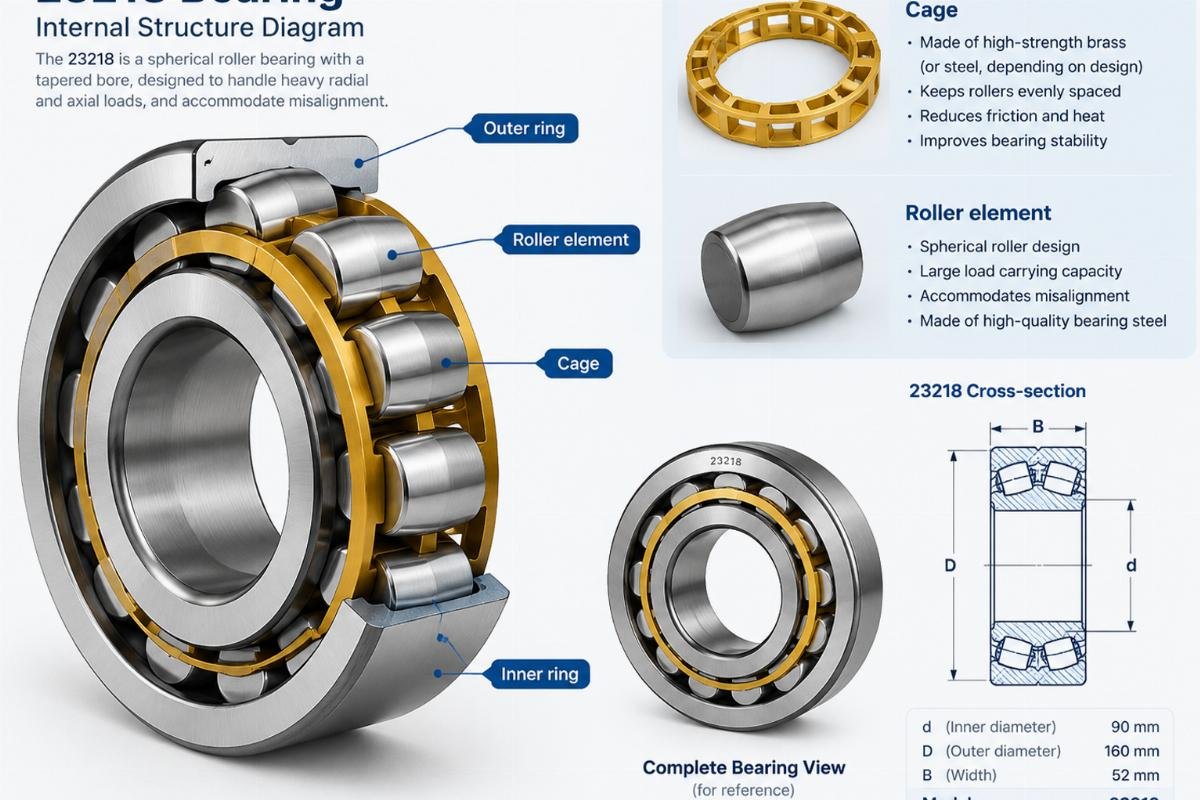
A 23218 bearing is a heavy-duty spherical roller bearing designed to accommodate misalignment and heavy radial loads.
Understanding the basic dimensions is the first step, but the devil is in the details. The 23218 designation follows the ISO standard numbering system, where the ’23’ indicates the series (wide, heavy-duty) and ’18’ indicates the bore diameter code. However, relying solely on bore and outer diameter is insufficient for critical applications. The cage type, internal clearance, and lubrication features are equally vital.
| Parameter | Specification Detail | Application Impact |
|---|---|---|
| Bore Diameter | 90 mm | Fits standard shaft sizes for heavy machinery |
| Outer Diameter | 160 mm | Provides robust housing support |
| Width | 52.4 mm | Accommodates large rollers for high load capacity |
| Cage Material | Brass (M) or Steel (J) | Determines thermal resistance and durability |
| Internal Clearance | C3, C4, or Normal | Manages thermal expansion during operation |
| Load Rating | High Dynamic & Static | Suitable for shock loads in crushers and mills |
[NEED_CITE: ISO 15243 standard for bearing nomenclature and dimensions]
A common mistake among buyers is focusing only on the bore and OD while ignoring the cage and clearance. For instance, a 23218 bearing with a stamped steel cage may fit physically but fail prematurely in high-temperature environments. Conversely, a brass-caged unit might be overkill for a low-temperature, light-load application, adding unnecessary cost. The table above highlights the key parameters, but the real value lies in how these specs interact with your specific operating conditions.

When sourcing a 23218 bearing, always request the full technical datasheet. Verify the cage material and internal clearance against your application requirements. Do not assume that all bearings with the same part number are identical. Variations in cage design and clearance can significantly impact performance and lifespan.
How to Choose the Right Cage Material for 23218?
Brass cages are not universally better; stamped steel cages can fail catastrophically above certain temperature thresholds, but brass is overkill for low-temperature light loads.
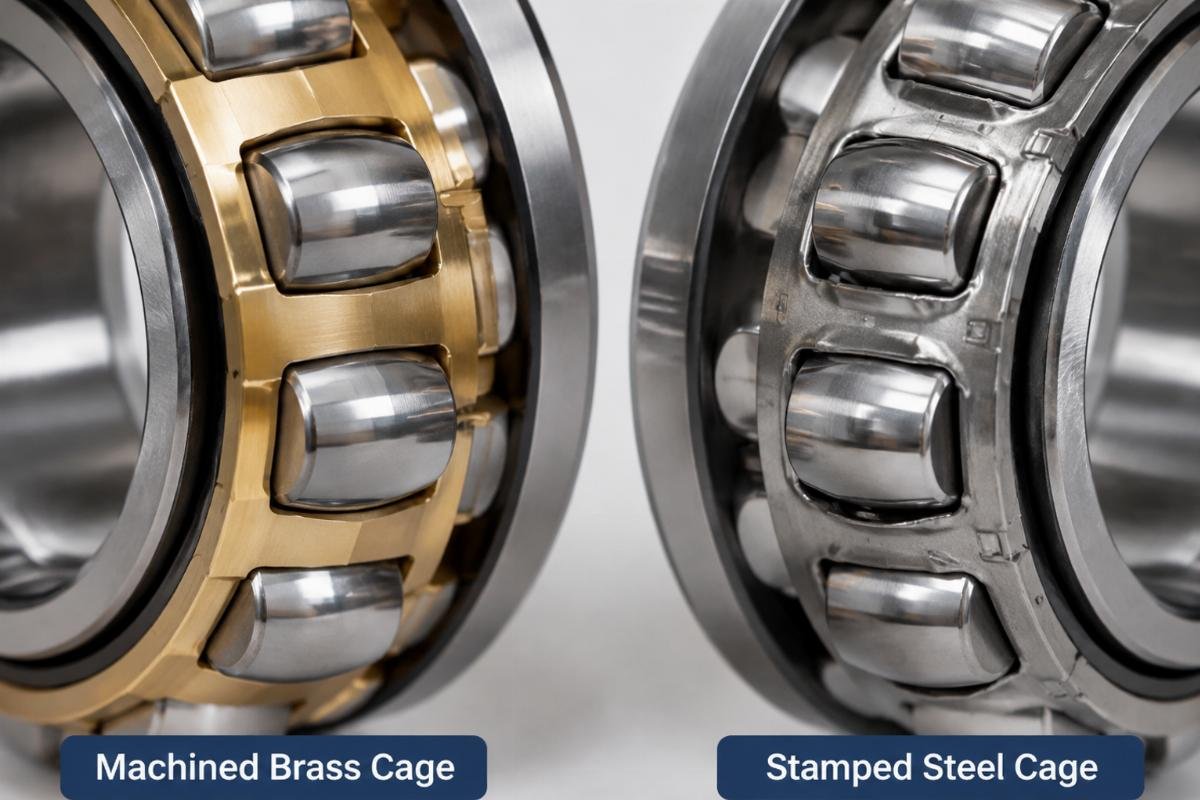
The cage holds the rollers in place and guides them during rotation. Its material determines how well the bearing handles heat, vibration, and shock. In the context of a 23218 bearing, the two most common cage materials are machined brass and stamped steel. Each has distinct advantages and limitations.
Machined brass cages offer excellent thermal stability and low friction. They are ideal for high-temperature applications, such as steel mill continuous casters or mining crushers where heat buildup is significant. Brass also dampens vibration better than steel, reducing noise and wear. However, brass is softer and more expensive. In extremely dusty or abrasive environments, brass cages can wear faster if not properly sealed and lubricated.
Stamped steel cages are cost-effective and suitable for moderate temperatures and loads. They are widely used in general industrial applications. However, they have a lower temperature limit. Above this threshold, the steel can lose temper, leading to deformation and eventual fracture. This was the root cause of the failure in the African gold mine case. The steel cages could not withstand the thermal shock, leading to rapid disintegration.
| Cage Material | Thermal Resistance | Shock Load Handling | Cost | Best For |
|---|---|---|---|---|
| Machined Brass | High | Excellent | Higher | High-temp, high-shock (mining, steel) |
| Stamped Steel | Moderate | Good | Lower | General industrial, moderate loads |
[NEED_CITE: Material properties comparison for bearing cages under thermal stress]
Choosing the wrong cage material is a costly error. For a 23218 bearing in a hot, high-shock environment, brass is the safer choice. For cooler, stable conditions, steel offers a budget-friendly solution without compromising performance. Always consider the operating temperature and load profile when making this decision.
Which Internal Clearance Fits Your 23218 Application?
Excessive clearance under heavy shock loads causes roller skew and spalling, not just free movement.
Internal clearance refers to the space between the rollers and the raceways. It is crucial for accommodating thermal expansion of the shaft and housing during operation. The most common clearance classes for a 23218 bearing are C3 and C4. Selecting the right one is a balancing act.
C3 clearance is the standard for many industrial applications. It provides enough space for moderate thermal expansion while maintaining precise roller alignment. C4 clearance offers more space, suitable for high-temperature environments where significant expansion is expected. However, more clearance is not always better.
In a steel mill continuous caster, the operating temperature can fluctuate widely. Using a C3 clearance in such an environment might lead to binding as the shaft expands. Conversely, using C4 clearance in a cooler application with heavy shock loads can cause the rollers to skew. This misalignment leads to uneven load distribution, increased stress, and premature spalling of the raceways.
| Clearance Class | Thermal Expansion Capacity | Stability Under Shock Load | Typical Application |
|---|---|---|---|
| Normal | Low | High | Low-temp, stable loads |
| C3 | Moderate | High | General industrial, moderate heat |
| C4 | High | Moderate | High-temp, significant expansion |
[NEED_CITE: Calculation logic for thermal expansion in bearing clearances]
The key is to match the clearance to the expected temperature rise and load conditions. For a 23218 bearing in a mining conveyor pulley, where dust and moderate heat are factors, C3 is often sufficient. For a steel mill roller table, where temperatures are higher, C4 might be necessary. Always calculate the expected thermal expansion and consult with a technical expert if unsure.

What Are the Typical Heavy-Duty Applications?
Sealing and lubrication intervals in dusty environments determine the relubrication cycle extension and dust ingress rate.
The 23218 bearing is a workhorse in several heavy industries. Its ability to handle misalignment and heavy loads makes it ideal for harsh environments. Understanding the specific challenges of each application helps in selecting the right configuration.
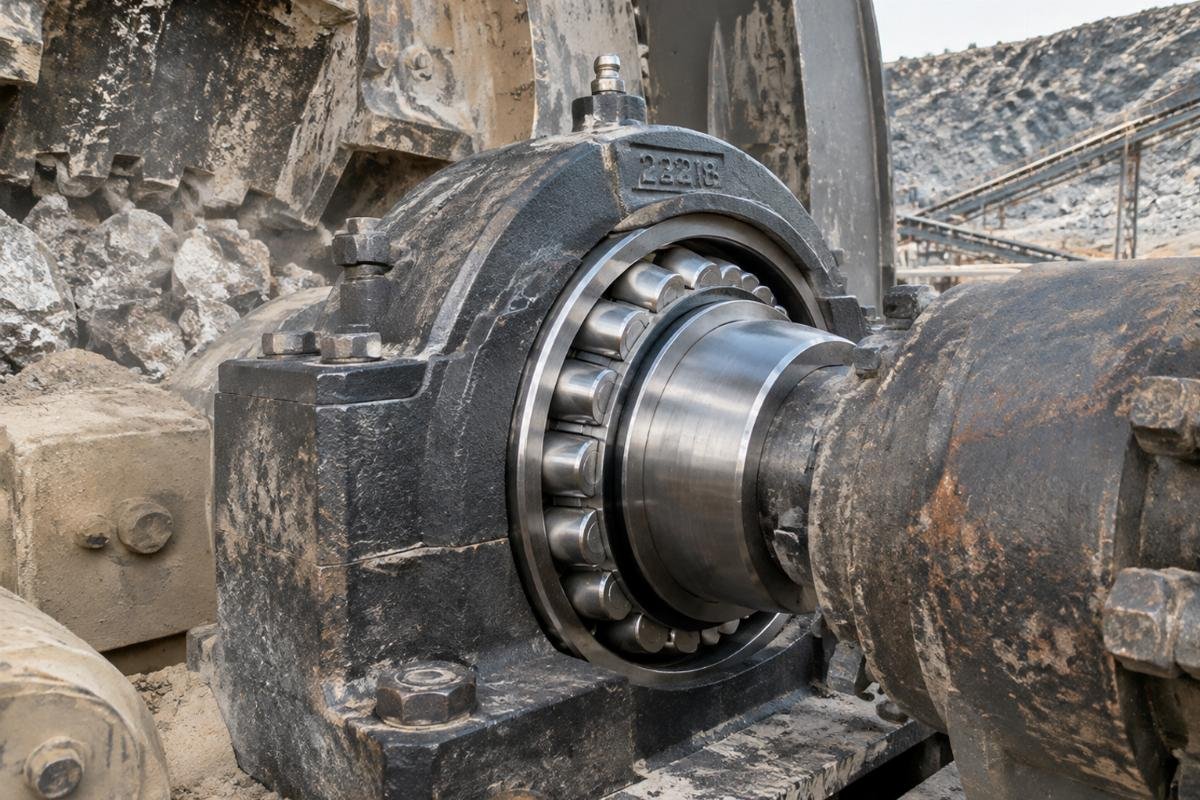
In mining crushers, the bearing faces extreme shock loads and dust. Here, a machined brass cage and effective sealing are critical. The sealing prevents dust ingress, which can abrade the raceways and rollers. Regular relubrication is also essential to flush out contaminants and maintain a protective film.
Steel mill continuous casters operate at high temperatures. Thermal expansion is a major concern, making C4 clearance and brass cages preferable. The bearing must withstand constant heat and heavy loads without failing. Proper lubrication with high-temperature grease is vital to prevent oxidation and wear.
Mining conveyor pulleys deal with continuous operation and moderate loads. Dust and moisture are common challenges. Effective sealing and regular maintenance are key to extending service life. A C3 clearance is often sufficient, provided the temperature remains within limits.
| Application | Key Challenge | Recommended Cage | Recommended Clearance |
|---|---|---|---|
| Mining Crusher | Shock load, dust | Brass | C3 or C4 |
| Steel Mill Caster | High temp, expansion | Brass | C4 |
| Conveyor Pulley | Dust, continuous run | Steel or Brass | C3 |
[NEED_CITE: Industry best practices for bearing maintenance in heavy industries]
Each application presents unique demands. By matching the 23218 bearing specifications to these demands, you can maximize performance and minimize downtime. Always consider the environmental factors, load profile, and maintenance capabilities when making your selection.
Conclusion
Match specs to conditions, not just catalogs.
Selecting the right 23218 bearing involves more than checking dimensions. It requires a careful consideration of cage material, internal clearance, and application-specific challenges. By understanding these factors, you can prevent premature failures and ensure reliable operation in heavy-duty environments. Whether you are sourcing for mining, steel, or cement plants, the right technical match is your best defense against downtime.


