23024 Bearing Dimensions & Equivalents: Wholesale Supplier
Matching outer dimensions is not enough for a successful replacement.
The standard 23024 bearing dimensions are 120mm inner diameter, 180mm outer diameter, and 46mm width. However, swapping brands without verifying internal clearance codes like C3 or cage material specifications often leads to premature seizure in heavy-load applications.
I still remember the humidity in the assembly workshop in Suzhou where I started my career. The air smelled of machine oil and metal dust. My job was simple: fit the rings, check the rotation, and pack. One day, a rush order came in for a mining client in the Middle East. They needed a batch of 23024 spherical roller bearings to replace worn units on a crusher. I pulled the stock that matched the 120x180x46mm size perfectly. It looked identical to the original SKF unit they had been using. I shipped it out, confident in the dimensional accuracy. Weeks later, the call came. The bearings had seized within days. The issue was not the size. The original equipment required a C3 internal clearance and a brass cage to handle the thermal expansion and vibration. I had supplied a standard clearance unit with a steel cage. The cost of that mistake was not just the refund; it was the loss of trust and the logistical nightmare of reverse shipping. That experience rewired how I view every part number. Now, when I look at a 23024 bearing, I see more than just millimeters. I see a system of tolerances, materials, and operational contexts that must align perfectly. [NEED_CITE: impact of internal clearance on thermal expansion in spherical roller bearings]

This guide breaks down the critical details behind the 23024 bearing dimensions and equivalents. It is designed for distributors and MRO operators who need to ensure that a cross-brand replacement does not become a costly failure. We will look beyond the basic size chart to understand why suffixes matter and how to verify authenticity in a mixed-brand supply chain.
What Are the Exact Dimensions of a 23024 Bearing?
The external geometry is standardized, but the internal architecture varies by manufacturer.
When you search for 23024 bearing dimensions, you are looking for a baseline. The ISO standard defines the boundary dimensions for this series. For a 23024 spherical roller bearing, the inner diameter is 120 mm, the outer diameter is 180 mm, and the width is 46 mm. These numbers are non-negotiable for fitment. If the housing bore is 180 mm, any deviation here means the bearing will not install. However, stopping your inspection at these three numbers is a common error that leads to field failures.
The 23024 belongs to the spherical roller bearing family, designed to accommodate misalignment and heavy radial loads. While the outer shell is consistent across brands like SKF, FAG, NSK, and domestic Chinese manufacturers, the internal design can differ. The radius of the raceways, the profile of the rollers, and the guide flange geometry are proprietary to each brand. This means that while a 23024 from Brand A will fit into the same housing as a 23024 from Brand B, the load distribution inside may behave differently under extreme stress. [NEED_CITE: ISO standards for spherical roller bearing boundary dimensions]
For wholesalers consolidating containers, understanding this distinction is vital. You can mix brands in a single shipment to optimize SKU variety, but you must ensure that the application allows for such interchangeability. In low-speed, moderate-load applications, the dimensional match is often sufficient. In high-vibration environments like mining crushers or steel mill conveyors, the internal geometry becomes critical.
| Parameter | Value | Note |
|---|---|---|
| Inner Diameter (d) | 120 mm | Standard ISO metric |
| Outer Diameter (D) | 180 mm | Standard ISO metric |
| Width (B) | 46 mm | Standard ISO metric |
| Basic Dynamic Load Rating | Varies by brand | Check specific catalog |
| Basic Static Load Rating | Varies by brand | Check specific catalog |
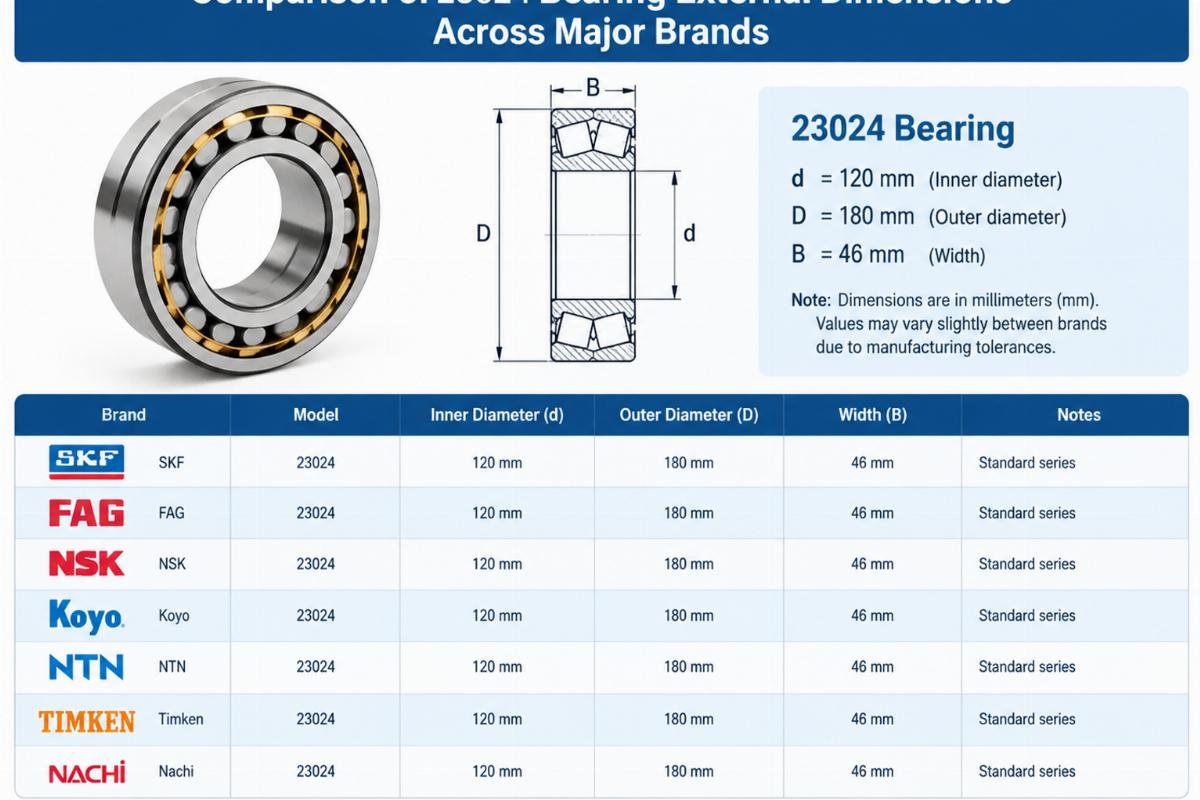
When sourcing 23024 equivalents, always request the full technical datasheet, not just the size chart. The load ratings, while not part of the physical dimensions, dictate whether the bearing can survive the application. A mismatch in load capacity, even with perfect dimensional fit, will result in early fatigue failure.
How Do 23024 Equivalents Compare Across SKF, FAG, and NSK?
Brand equivalence is not just about part numbers; it is about suffix mapping.
A 23024-2RS from one brand is not automatically identical to a 23024-2RS from another. The suffixes denote specific features such as seals, cages, and clearances. When building a cross-reference matrix for your inventory, you must map these suffixes carefully. For example, SKF uses specific codes for their brass cages, while FAG and NSK have their own nomenclature. Ignoring these differences can lead to installing a bearing with a steel cage in an application that requires the damping properties of brass.
In the global market, SKF, FAG, and NSK are the primary benchmarks. Domestic Chinese brands like ZWZ, HRB, and LYC offer reliable alternatives that meet ISO standards. The key is to verify that the domestic equivalent matches the critical suffixes of the original imported brand. If the original spec calls for a C3 clearance, the replacement must also be C3. A standard clearance bearing in a high-temperature environment will expand and lock up.
Consider a case involving a regional wholesaler in Southeast Asia. They were supplying replacements for a cement plant. The plant used FAG bearings with specific high-temperature grease and C4 clearance. The wholesaler substituted them with a standard clearance equivalent from a different brand, assuming the 23024 dimensions were the only constraint. The bearings failed within weeks due to thermal expansion. The lesson here is that the 23024 bearing cross reference must include clearance and cage data, not just the base number. [NEED_CITE: effect of internal clearance on bearing life in high-temperature applications]
| Feature | SKF Convention | FAG/INA Convention | NSK Convention | General Equivalent Note |
|---|---|---|---|---|
| Brass Cage | Usually M or no suffix in some series | M | M | Verify material composition |
| Steel Cage | J or no suffix in some series | F80 | – | Common in standard series |
| C3 Clearance | C3 | C3 | C3 | Standardized across brands |
| Sealed Type | 2RS1 | 2RSR | LU | Check seal material compatibility |

For MRO operators, maintaining a database of these suffix mappings is essential. It allows for faster decision-making during emergency breakdowns. When you source from a supplier who understands these nuances, you reduce the risk of sending the wrong variant. Our approach involves verifying the suffix requirements against the original equipment manufacturer’s documentation before confirming any cross-brand substitution.
Why Do Suffixes Like C3 and Brass Cages Matter in Replacements?
Internal clearance and cage material dictate survival under shock loads.
The difference between a bearing that lasts five years and one that fails in five days often lies in two characters: the clearance code and the cage type. For 23024 bearings used in heavy machinery, standard clearance is rarely sufficient. The C3 clearance provides extra internal space to accommodate thermal expansion of the shaft and housing. Without it, the rolling elements bind as temperatures rise, leading to rapid heat generation and seizure.
Brass cages offer another layer of protection. In high-vibration applications, such as crushers or vibrating screens, steel cages can suffer from fatigue cracks. Brass is more resilient to vibration and offers better emergency running properties if lubrication is temporarily lost. I have seen OEMs switch from steel to brass cages for their heavy-duty crushers, resulting in a noticeable extension of service life. The cost difference is marginal compared to the downtime saved.
A Middle East mining client once replaced a set of 23024 bearings ignoring the C3 requirement. The ambient temperature was high, and the operational load was severe. The standard clearance bearings seized, causing hours of unplanned downtime. The cost of the replacement bearings was negligible compared to the lost production time. This is why we emphasize verifying the suffixes. It is not just about having the right size; it is about having the right specification for the environment. [NEED_CITE: guidelines for selecting internal clearance in spherical roller bearings]
When sourcing 23024 equivalents, always ask for the clearance class. If the original is C3, do not accept standard clearance. Similarly, check the cage material. If the application involves heavy shock loads, specify a brass cage. These details are often overlooked in quick replacements, but they are critical for long-term reliability.
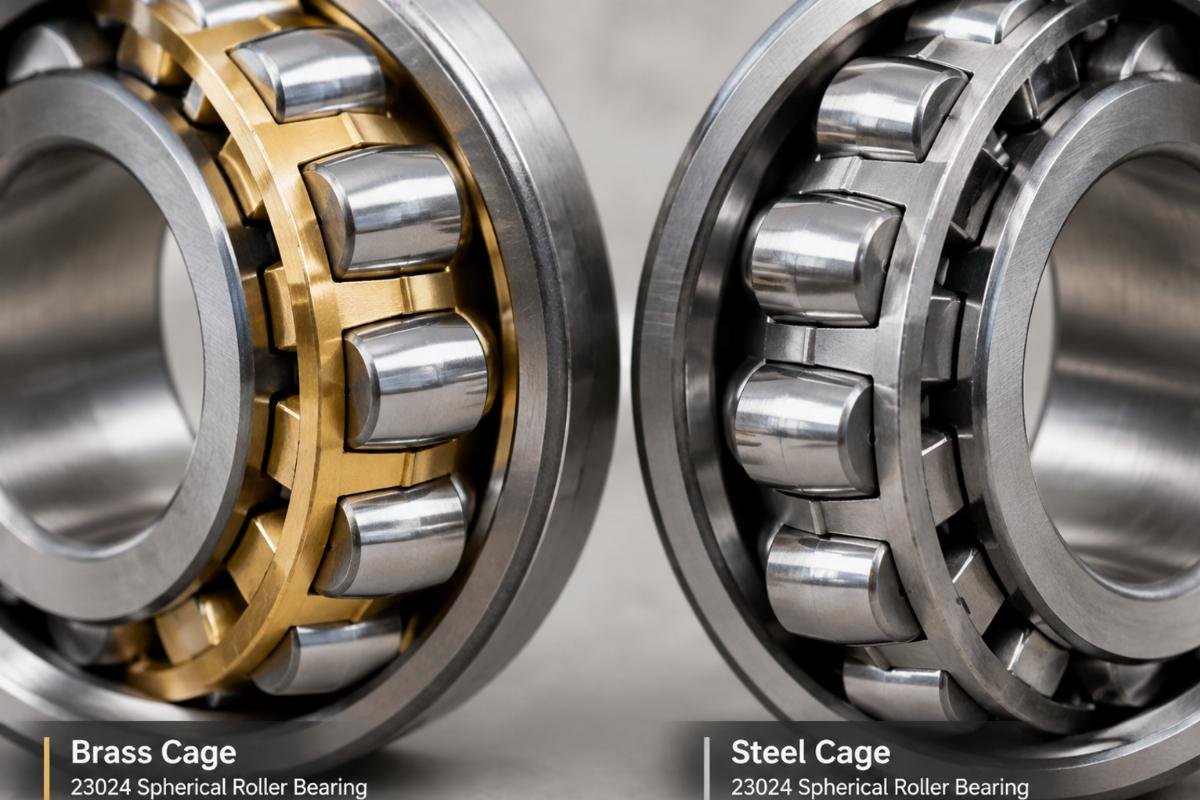
Our inventory includes a wide range of 23024 variants with different suffixes. We maintain spot stock of C3 and C4 clearance units with both steel and brass cages. This allows us to provide immediate replacements that match the exact technical requirements of the original equipment, minimizing the risk of field failures.
How to Verify Authenticity and Specs When Sourcing Equivalents?
Traceability documents and physical inspection are your best defenses against counterfeits.
The market for popular bearings like the 23024 is flooded with counterfeits. These fakes often look perfect on the outside but use inferior steel and poor heat treatment. To protect your operations, you must implement a rigorous verification process. Start with the packaging. Genuine bearings come in high-quality boxes with clear printing and holographic labels. Check the part number, batch code, and manufacturer logo for any inconsistencies.
Next, inspect the bearing itself. Look for smooth, precise machining on the raceways and rollers. Counterfeit bearings often have rough surfaces or inconsistent grinding marks. Check the cage for burrs or weak spots. A genuine brass cage will have a uniform color and solid construction. Finally, request traceability documentation. Reputable suppliers can provide certificates of origin and material test reports. These documents link the bearing to its production batch, ensuring authenticity.
A European wind farm operator once received a shipment of 23024 bearings that looked genuine. However, upon installation, they noticed unusual noise. Further inspection revealed poor surface finish on the rollers. The supplier could not provide traceability docs. The entire batch was rejected, saving the operator from potential catastrophic failure. This highlights the importance of demanding proof of authenticity. [NEED_CITE: methods for identifying counterfeit rolling bearings]
| Verification Step | What to Check | Red Flag |
|---|---|---|
| Packaging | Print quality, holograms, batch codes | Blurry text, missing holograms |
| Bearing Surface | Smoothness, grinding marks | Rough patches, visible tool marks |
| Cage Material | Uniformity, strength | Burrs, discoloration, weak joints |
| Documentation | Certificate of origin, material test report | Unable to provide docs, vague info |

When working with a global supplier, ensure they have a robust quality assurance system. Ask about their sourcing channels and inspection processes. A reliable partner will welcome these questions and provide the necessary documentation to prove the genuineness of their products. This level of transparency is crucial for building a sustainable supply chain.
Conclusion
Precision in specification prevents failure in operation.
The 23024 bearing dimensions of 120x180x46mm are just the starting point. True reliability comes from matching internal clearances, cage materials, and load ratings to the specific application. By understanding the nuances of suffixes and verifying authenticity through traceability, you can ensure that your cross-brand replacements perform as expected. Avoid the trap of assuming dimensional equality means functional equivalence. Always dig deeper into the technical details to protect your equipment and your reputation.