
22316 Bearing Dimensions & Equivalents: Wholesale Supplier
Identical outer dimensions do not guarantee interchangeability.
The standard 22316 bearing dimensions are 80 mm bore, 170 mm outside diameter, and 58 mm width. However, successful substitution across brands like SKF, FAG, and NSK requires verifying internal clearance classes (C3/C4) and cage design suffixes, not just the envelope size.
I still recall the humidity in Lagos during a cement plant commissioning project. The vibration screens were ready for startup, but the imported 22316 spherical roller bearings refused to seat properly in the housings. We had matched the 80x170x58mm envelope perfectly, assuming any major brand equivalent would drop in. We were wrong. The issue was not the outer dimensions but the internal radial clearance. The specified C4 clearance for high-temperature vibrating applications had been substituted with a standard C3 group from a different manufacturer without updating the housing fit tolerances. The resulting interference caused immediate overheating. The cost of air-freighting the correct stock exceeded the original order value, and the customs delay stretched into weeks due to documentation mismatches on the replacement shipment. This incident reinforced that mastering 22316 bearing dimensions and equivalents is less about reading a catalog and more about understanding the tolerance stack-up in real-world assemblies. [NEED_CITE: ISO 492 dimensional tolerance standards for rolling bearings]

Sourcing these components for heavy machinery maintenance demands a rigorous approach to cross-referencing. Below, we break down the exact specifications, brand equivalencies, and critical verification steps to prevent costly assembly failures.
What Are the Exact Dimensions of a 22316 Bearing?
The 22316 designation follows a strict ISO metric code, but weight and internal geometry vary by manufacturer.
At its core, the 22316 is a spherical roller bearing designed to accommodate misalignment and heavy radial loads. The primary envelope dimensions are standardized globally, ensuring that a 22316 from one reputable source will physically fit into a housing machined for another. However, relying solely on these three numbers is a common pitfall for procurement teams.
The basic dimensions are:
- Bore Diameter (d): 80 mm
- Outside Diameter (D): 170 mm
- Width (B): 58 mm
While these figures are constant, the mass of the bearing can differ slightly depending on the cage material (steel vs. brass) and the specific internal design of the roller complement. For logistics and structural load calculations, knowing the approximate weight is essential, though it should always be verified against the specific brand’s datasheet. A typical 22316 weighs approximately 6 to 7 kg, but this varies. [NEED_CITE: General mass range for series 223 spherical roller bearings]
More critical than weight is the chamfer dimension and the radius of the housing shoulder. If the replacement bearing has a larger corner radius than the original, it may not seat fully against the shaft shoulder, leading to fretting corrosion under load. When evaluating 22316 bearing dimensions and equivalents, always request the detailed drawing for the specific batch, not just the generic catalog page.

How Do 22316 Equivalents Compare Across SKF, FAG, and NSK?
Suffix codes define the internal architecture, making direct part number swaps risky without technical review.
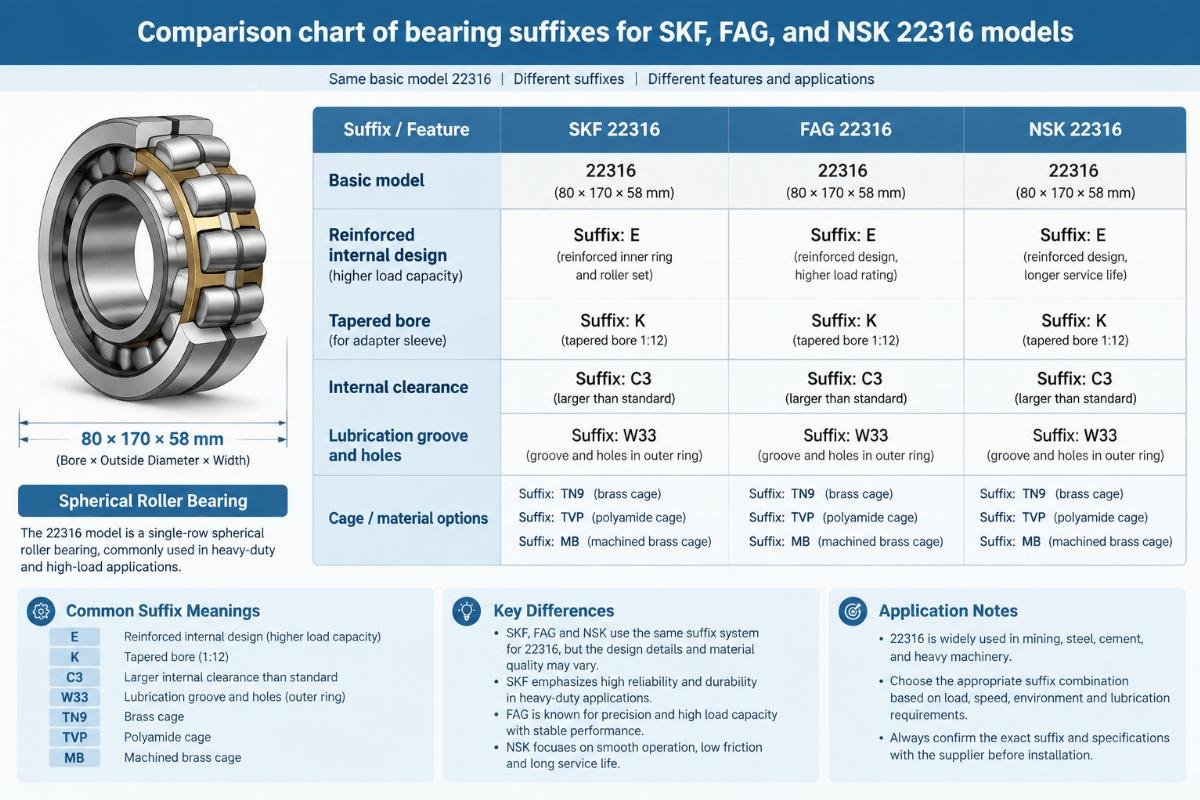
A frequent error in MRO procurement is assuming that “22316” is a complete part number. In reality, it is merely the base series. The functional equivalence between brands like SKF, FAG, NSK, and others depends entirely on the suffixes that denote cage type, clearance, and sealing.
Consider the following comparison of common configurations found in heavy industry. Note that while the envelope dimensions remain 80x170x58mm, the operational characteristics differ significantly.
| Feature | Standard Industrial (e.g., C3) | Heavy Duty/Vibrating (e.g., C4) | High Precision/Spindle |
|---|---|---|---|
| Internal Clearance | Normal to Slightly Increased | Increased for Thermal Expansion | Reduced for Rigidity |
| Cage Material | Often Steel or Polyamide | Brass or Machined Steel | High-grade Polyamide or Steel |
| Typical Suffixes | None or C3 | C4, E4 (FAG), CC (SKF) | P5, P4 Precision Class |
| Application Fit | General Motors, Fans | Vibrating Screens, Crushers | Machine Tool Spindles |
[NEED_CITE: ABMA standard definitions for radial internal clearance groups]
For instance, an SKF 22316 CC/W33 might be functionally equivalent to an FAG 22316-E4-K-C4, but only if the application demands high load capacity and increased clearance. Swapping a C3 bearing for a C4 equivalent in a precision gearbox can lead to excessive play and premature failure. Conversely, using a C3 in a vibrating screen that requires C4 will cause the rollers to bind as the bearing expands under heat and load.
When sourcing 22316 bearing dimensions and equivalents, distributors must map these suffixes carefully. A mismatch here does not show up during visual inspection but manifests as catastrophic failure within hours of operation. Our consultation process involves cross-referencing these suffixes against the OEM’s original bill of materials to ensure the internal design matches the operational stress profile, not just the shaft size.
Why Do Clearance Tolerances Matter in Brand Substitution?
Internal clearance dictates thermal performance and load distribution, not just fit.
The most counter-intuitive aspect of bearing substitution is that a “looser” fit inside the bearing (higher clearance) is often required for a “tighter” fit in the housing. This is particularly true for the 22316 series used in harsh environments.
Clearance classes such as C2, C3, C4, and C5 refer to the radial internal clearance before installation. As a bearing operates, friction generates heat, causing the inner ring to expand more than the outer ring due to its smaller mass and direct contact with the rotating shaft. If the initial clearance is insufficient, this thermal expansion eliminates the running gap, leading to pre-loading. Pre-loading drastically increases friction, temperature, and wear, often resulting in seizure.
In vibrating applications, such as screens in mining or aggregate processing, the dynamic loads also affect the effective clearance. A bearing with standard clearance may experience momentary zero-clearance conditions under peak load, causing metal-to-metal contact between rollers and raceways. Upgrading to a C4 or even C5 clearance provides the necessary buffer to maintain a lubricant film under these extreme conditions. [NEED_CITE: ISO 5753 standards for radial internal clearance]
We once supplied a batch of 22316 units to a steel mill in Southeast Asia. The client requested a direct equivalent for a discontinued brand. The original spec called for C4 clearance. The available alternative was stocked in C3. Technically, the C3 unit would fit the shaft and housing. However, under the operating temperature of 90°C, the C3 clearance would effectively vanish. We flagged this discrepancy and sourced the correct C4 variant. The client initially hesitated due to a slight price difference, but the alternative would have led to unplanned downtime costing far more than the bearing itself. This highlights why verifying clearance is non-negotiable when dealing with 22316 bearing dimensions and equivalents.

How to Verify 22316 Bearings Before Installation and Customs?
Traceability documentation and physical measurement are the only safeguards against counterfeit or mislabeled stock.
Even with perfect specification matching, the risk of receiving non-conforming goods remains. Global supply chains are rife with mixed batches where labels may match, but the product inside does not. For MRO operators and distributors, verification must happen before the bearing reaches the machine.
First, insist on full traceability. Genuine bearings from major manufacturers carry unique identification codes that link back to the production batch. These codes should be verifiable through the manufacturer’s official channels or authorized distributor networks. Lack of such documentation is a primary red flag.
Second, perform physical spot checks. While you cannot measure internal clearance without specialized tools, you can verify the envelope dimensions and surface finish. Use calibrated micrometers to check the bore and outside diameter against the ISO 492 tolerance limits. Check the chamfers for consistency and the cage for secure riveting. Any deviation in surface roughness or dimensional accuracy suggests substandard manufacturing or potential counterfeiting.
Customs authorities in many regions are increasingly stringent regarding industrial components. Discrepancies between the declared HS code, the brand name, and the physical markings on the bearing can lead to seizures. Ensuring that the packaging, labeling, and product markings are consistent and authentic protects against these delays. [NEED_CITE: World Customs Organization guidelines on intellectual property rights enforcement]
When we handle global shipments, we ensure that every unit of 22316 bearing dimensions and equivalents is accompanied by the necessary certificates of origin and conformity. This documentation not only facilitates smoother customs clearance but also provides the end-user with the confidence that the component meets the specified engineering standards. For urgent replacements, this level of diligence prevents the double penalty of delayed freight and rejected goods.

Conclusion
Precision in substitution prevents expensive operational failures.
Mastering the nuances of the 22316 series goes beyond memorizing the 80x170x58mm envelope. It requires a deep understanding of internal clearance, cage design, and brand-specific suffixes. By prioritizing technical verification over simple part number matching, buyers can avoid the hidden costs of downtime and logistical errors. Reliable sourcing partners provide not just the hardware, but the technical assurance needed for critical heavy-industry applications.


