22318 Bearing Specs & Vibrating Screen Uses Wholesale Supplier
Standard clearance is a death sentence for vibrating screens.
The 22318 spherical roller bearing, with its 90x190x64mm dimensions, is engineered for heavy radial loads, but surviving the harsh environment of a vibrating screen requires more than just size. Success depends on specifying C3 or C4 internal clearance and robust brass cages to accommodate thermal expansion and resist dust ingress. Standard off-the-shelf units will fail prematurely under continuous vibration and heat.
I still remember the smell of burnt grease and the silence of a stopped production line in a nickel mine in Indonesia. It was my third month handling equipment procurement, and the primary vibrating screen had seized up. The culprit was a batch of 22318 bearings that looked perfect on paper. They met the dimensional standards, but they had standard internal clearance. Under the continuous operation and ambient heat of the tropics, the inner rings expanded, eliminated the running clearance, and locked solid. We lost three days of production while we ripped out the failed units and sourced replacements with higher clearance. That failure taught me that in heavy industry, the part number is just the starting point. The real specification lies in the operating environment. [NEED_CITE: impact of thermal expansion on bearing internal clearance]

When you are sourcing for mining or aggregate processing, you cannot treat a 22318 bearing as a generic commodity. The difference between a unit that lasts six months and one that lasts two years often comes down to two specific choices: internal clearance and cage material. This guide breaks down the technical specs that matter and how to verify them before they reach your site.
What Are the Core Specs of the 22318 Bearing?
Dimensions define fit, but load ratings define capability.
The 22318 bearing is a member of the spherical roller bearing family, designed to accommodate misalignment and heavy shock loads. Its physical footprint is fixed at 90mm bore, 190mm outer diameter, and 64mm width. These dimensions are standardized globally, meaning a 22318 from any major manufacturer will fit the same housing. However, the performance within that envelope varies significantly based on internal design.
The dynamic load rating (Cr) and static load rating (Cor) are the primary metrics for selection. For a standard 22318, these ratings allow it to handle substantial radial forces typical in crushers and screens. Yet, many buyers stop here. They assume that if the load rating matches the application, the bearing will survive. This is a critical oversight. The limiting speed and lubrication requirements are equally vital. A 22318 running in a vibrating screen operates under constant acceleration and deceleration, which places unique stress on the rolling elements and cage. [NEED_CITE: ISO standards for spherical roller bearing load ratings]
| Parameter | Standard Value / Characteristic | Application Note |
|---|---|---|
| Bore Diameter | 90 mm | Fixed dimensional standard |
| Outer Diameter | 190 mm | Fixed dimensional standard |
| Width | 64 mm | Fixed dimensional standard |
| Internal Clearance | C0 (Standard), C3, C4 | C3/C4 required for high temp/vibration |
| Cage Material | Steel, Brass, Polyamide | Brass preferred for high vibration |
| Load Type | Radial, Moderate Axial | High radial capacity |
In my early days, I saw distributors ship standard C0 clearance units because they were cheaper and readily available. On a stationary motor, this might work. On a vibrating screen, where the housing heats up and the shaft expands, C0 clearance disappears quickly. Once the clearance is gone, friction spikes, temperature rises further, and failure is imminent. When evaluating a 22318 bearing for heavy-duty use, always confirm the clearance class first.

Why Do Standard 22318 Bearings Fail on Vibrating Screens?
Heat and dust are silent killers, not just external contaminants.
Vibrating screens are among the most hostile environments for rotating equipment. The combination of continuous vibration, high ambient temperatures, and abrasive dust creates a perfect storm for bearing failure. A standard 22318 bearing, designed for general industrial use, lacks the specific defenses needed to survive here.
The primary mode of failure is not usually fatigue from load, but rather lubrication breakdown and contamination. In a vibrating screen, the centrifugal force can throw grease away from the critical contact zones. If the bearing does not have a cage designed to retain lubricant effectively, the rollers run dry. [NEED_CITE: lubrication failure modes in vibratory machinery] Furthermore, the vibration itself generates heat. As the bearing temperature rises, the steel components expand. If the internal clearance is too tight, this expansion leads to pre-loading, which generates even more heat. It is a vicious cycle that ends in seizure.
Dust ingress is the second major threat. Mining and cement plants are filled with fine particulate matter. Standard seals or open designs allow this dust to enter the raceway. Once inside, the abrasive particles act like grinding paste, wearing down the rollers and races rapidly. I have seen bearings that looked new on the outside but were destroyed internally by dust contamination within weeks.
A European aggregate crusher operator once told me they switched from standard steel-cage 22318 units to brass-cage variants with enhanced sealing. The change did not increase the load capacity, but it doubled the mean time between failures. The brass cage was more resistant to the vibrational stresses that can fracture steel cages, and the improved sealing kept the dust out. This was not a magic fix; it was a match between component design and environmental reality.

Which 22318 Variants Suit Vibrating Screens Best?
Not all 22318 bearings are created equal for harsh conditions.
Selecting the right variant requires balancing clearance, cage material, and sealing. There is no single “best” option for every scenario, but there are clear preferences for vibrating screen applications. The goal is to maximize reliability and minimize unplanned downtime.
Internal clearance is the most critical factor. For vibrating screens, C3 clearance is often the minimum requirement. In hotter climates or heavier loads, C4 clearance is preferable. These larger clearances provide the necessary room for thermal expansion without causing binding. [NEED_CITE: recommended internal clearance for vibratory applications]
Cage material is the next key decision. Steel cages are strong and cost-effective, but they can be brittle under high vibration. Brass cages are more durable in these conditions. They have better sliding properties and are less prone to fracture from the constant shaking. Some modern designs use polyamide cages, which are lightweight and good for high speeds, but in high-temperature mining environments, brass remains the gold standard for durability.
| Feature | Standard Option | Recommended for Vibrating Screens | Reason |
|---|---|---|---|
| Internal Clearance | C0 (Normal) | C3 or C4 | Accommodates thermal expansion |
| Cage Material | Steel | Brass | Resists vibration-induced fracture |
| Sealing | Open or Basic Shield | Enhanced Seals / Labyrinth | Prevents dust ingress |
| Lubrication | Standard Grease | High-Temp / EP Grease | Withstands heat and load |
Sourcing these specific variants requires a supplier who understands the application. Many generalist distributors will quote the cheapest 22318 bearing available, which is usually a C0 clearance unit with a steel cage. This might save money upfront, but the cost of replacement and downtime far outweighs the initial savings. When requesting quotes, explicitly specify C3 or C4 clearance and brass cages. Verify these details in the product documentation before shipment.

How to Verify Quality Before Sourcing 22318 Bearings?
Trust but verify, especially with critical spares.
The market is flooded with bearings that claim to meet international standards but fall short in material quality and precision. For a 22318 bearing used in a vibrating screen, subpar quality leads to rapid failure. Verification starts with documentation and ends with physical inspection.
First, demand traceability. Genuine bearings from reputable manufacturers come with certificates of conformity that link the batch to the production records. These documents should confirm the material grade, heat treatment process, and dimensional tolerances. [NEED_CITE: importance of material certification in bearing quality] If a supplier cannot provide this, walk away. There is no way to verify the internal quality of a sealed bearing without destructive testing, so paperwork is your primary shield against counterfeits.
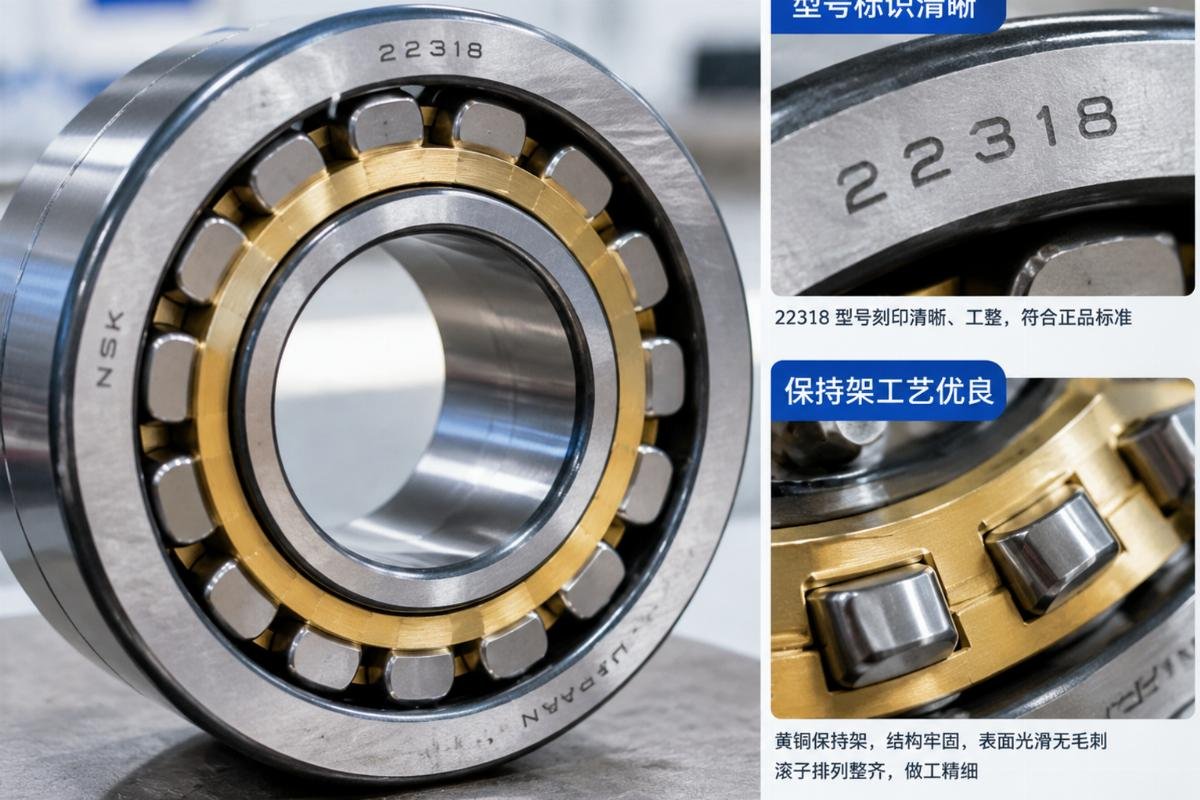
Second, inspect the physical attributes. Check the marking on the bearing ring. It should be clear, deep, and consistent. Fuzzy or shallow markings are a red flag. Examine the cage for smoothness and uniformity. A brass cage should have a consistent color and no visible cracks or rough edges. Rotate the bearing by hand. It should turn smoothly without any gritty feeling or uneven resistance. Any roughness suggests poor manufacturing or contamination.
I once received a shipment of 22318 bearings that looked authentic from the outside. The packaging was correct, and the markings were sharp. However, when we opened a sample unit, the rollers had slight surface imperfections that would have caused premature fatigue. The supplier had mixed lower-grade stock with genuine products. Because we inspected a sample before installing the full batch, we avoided a potential catastrophic failure on site.
Conclusion
The right 22318 bearing is defined by its environment, not just its dimensions.
Surviving the rigors of a vibrating screen requires moving beyond basic size specifications. Prioritize C3 or C4 internal clearance to handle thermal expansion and select brass cages for superior vibration resistance. Verify quality through rigorous documentation checks and physical inspection to ensure you are getting genuine, reliable components. By focusing on these technical details, you protect your operations from costly downtime and extend the life of your heavy equipment.