6317 Bearing Dimensions & Motor Uses: Wholesale Supplier
Standard clearance fails in high-heat motor applications.
The exact 6317 bearing dimensions are 85 mm bore, 180 mm outer diameter, and 48 mm width. For industrial motors operating in elevated temperatures, selecting a C3 internal clearance is mandatory to prevent thermal seizure, whereas standard C0 clearance leads to premature failure.
I learned this distinction the hard way during a shipment to the Middle East. The order consisted of deep groove ball bearings for large ventilation fans. The documentation listed the correct 6317 bearing dimensions, but the internal clearance was unspecified. I assumed standard C0 would suffice, as it does for most room-temperature machinery. The motors seized within weeks. The heat generated during operation caused the inner rings to expand more than the housing could accommodate, eliminating the running clearance entirely. The balls locked up. That loss taught me that dimensional accuracy is only half the equation; thermal dynamics dictate the rest. Now, every inquiry for motor applications starts with a question about operating temperature, not just size.

Understanding why these specific metrics matter requires looking beyond the catalog numbers. The physical size defines the load capacity, but the internal play determines survival in harsh environments.
What Are the Exact Dimensions of a 6317 Bearing?
The 85x180x48 mm profile defines the load boundary for heavy-duty shafts.
A 6317 unit belongs to the medium-heavy series of deep groove ball bearings. The bore diameter of 85 mm fits substantial motor shafts, while the 180 mm outer diameter provides the surface area needed to distribute radial loads across the housing. The 48 mm width allows for a larger complement of balls compared to narrower series, enhancing axial load capacity in both directions. [NEED_CITE: ISO 15 standard for boundary dimensions of rolling bearings]
These 6317 bearing dimensions are standardized globally under ISO 492. This means a bearing from one manufacturer will physically fit the housing designed for another, provided the tolerances match. However, fit is not function. A bearing can slide into place perfectly and still fail if the internal geometry does not account for operational stress.
| Parameter | Value | Standard Reference |
|---|---|---|
| Bore Diameter | 85 mm | ISO 15 |
| Outer Diameter | 180 mm | ISO 15 |
| Width | 48 mm | ISO 15 |
| Dynamic Load Rating | High | Manufacturer Catalog |
| Static Load Rating | High | Manufacturer Catalog |
The dynamic load rating indicates how much weight the bearing can handle while rotating. For the 6317 size, this rating is significant, making it a common choice for pumps, compressors, and large electric motors. Yet, buyers often fixate on these load numbers while ignoring the clearance class. A high load rating means nothing if the bearing jams due to thermal expansion.
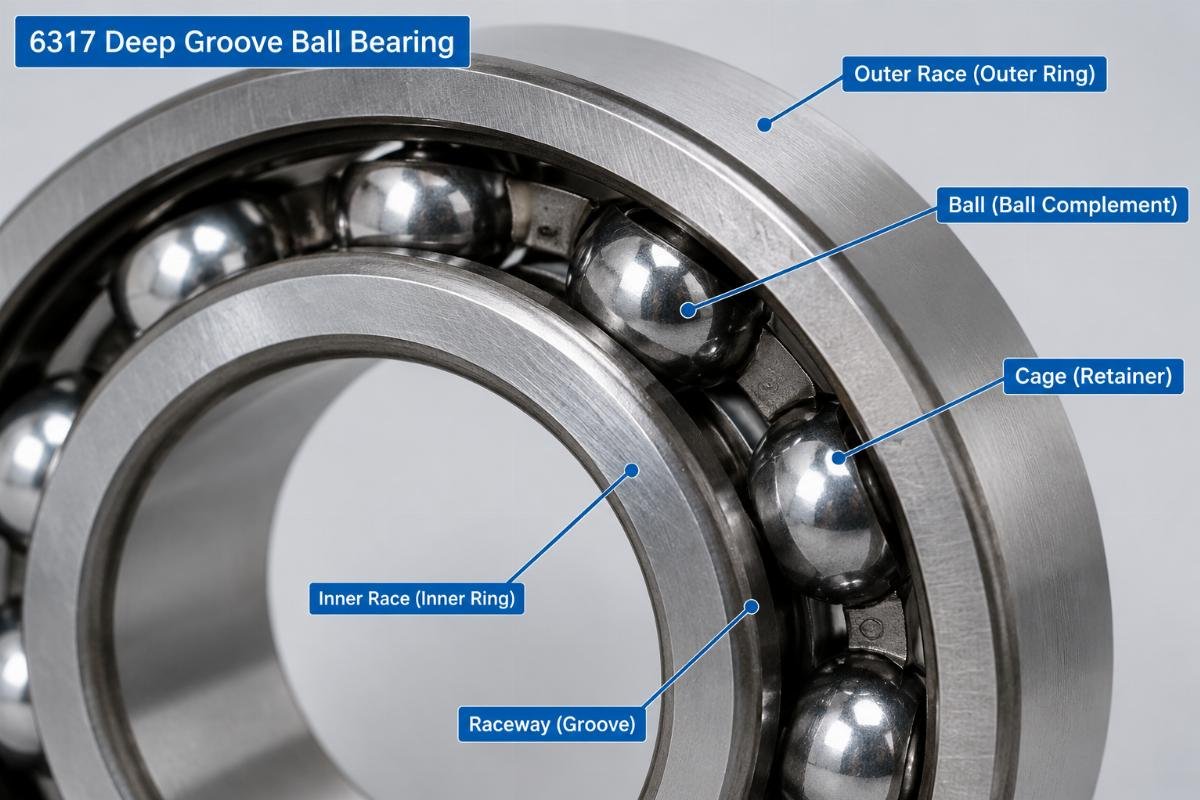
When sourcing these components, verifying the 6317 bearing dimensions against your shaft and housing drawings is the first step. But the second step, checking the clearance code, is where many procurement errors occur.
Why Are 6317 Bearings Ideal for Industrial Motors?
Deep groove geometry handles combined loads in continuous-duty cycles.
Industrial motors do not just spin; they vibrate, thrust, and carry radial weight from belts or couplings. The deep groove design of the 6317 allows it to manage these combined loads effectively. Unlike angular contact bearings which are optimized for pure axial thrust, the 6317 offers a balanced performance profile suitable for general-purpose motor drives.
In fan applications, the motor shaft often experiences slight misalignment due to thermal growth of the frame. The 6317’s design accommodates minor misalignments without inducing excessive edge stresses on the balls. This resilience is why you see this size in everything from HVAC blowers to mining exhaust systems. [NEED_CITE: Application guidelines for deep groove ball bearings in electric motors]
However, the environment dictates the specification. A motor running at ambient temperature in a warehouse has different needs than one installed in a steel mill’s cooling tower. The latter generates intense heat. If you use a standard bearing in that heat, the metal expands. The inner ring grows faster than the outer ring because it is closer to the heat source (the rotor). This growth eats up the internal clearance.
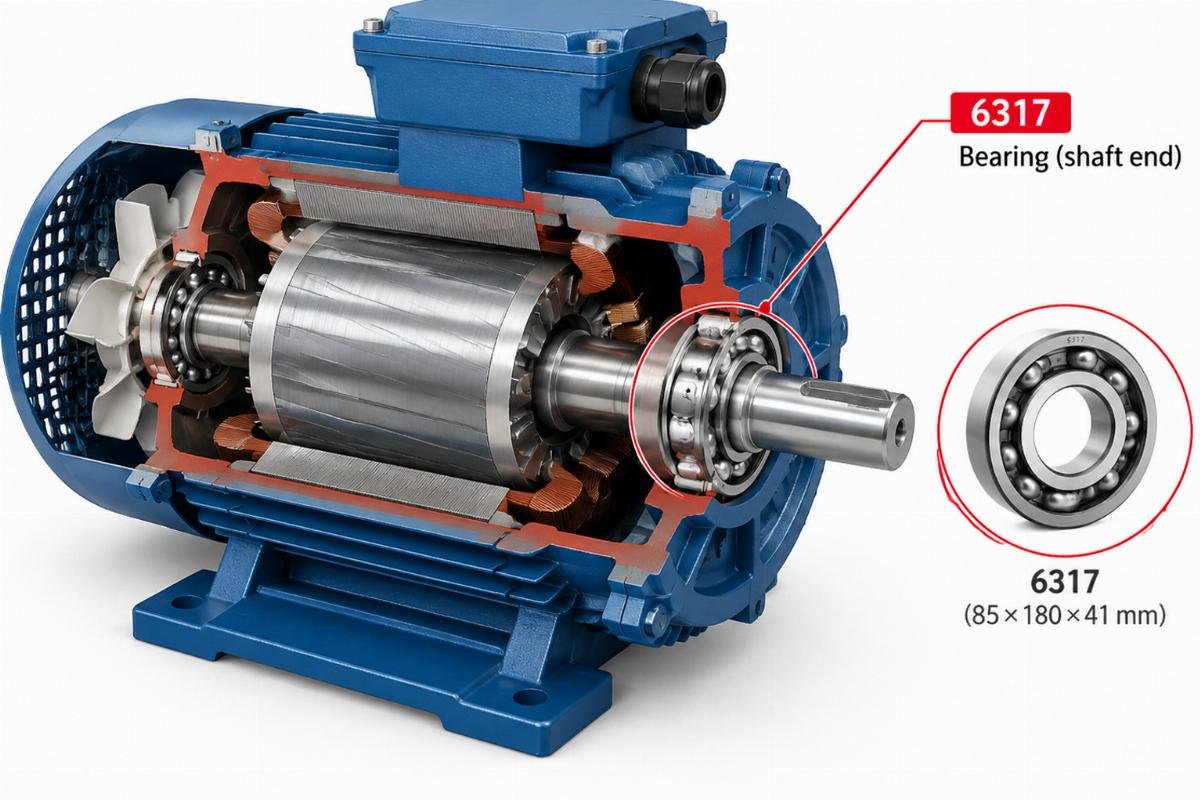
For 6317 bearing motor uses, the key is matching the bearing’s internal play to the expected thermal expansion. If the clearance is too tight, the bearing preloads itself unintentionally. This preload generates friction, which creates more heat, which causes more expansion. It is a feedback loop that ends in catastrophic seizure.
How Does Clearance (C0 vs C3) Affect Motor Performance?
C3 clearance prevents thermal jamming by accommodating expansion.
Internal clearance is the space between the balls and the raceways when the bearing is unloaded. Standard clearance, known as C0 or CN, is sufficient for most applications. But in high-temperature environments, C0 is dangerous. C3 clearance provides extra internal space. This additional room allows the inner ring to expand without pressing the balls tightly against the outer ring.
I once assisted a client replacing bearings in a heavy-duty pump system. They had been using standard clearance bearings and experiencing failures every few months. Switching to C3 clearance extended the operational lifespan noticeably. The pump operated in a hot, humid environment where temperature fluctuations were common. The C3 clearance absorbed the thermal growth, maintaining smooth rotation. [NEED_CITE: Technical explanation of radial internal clearance classes C0 vs C3]
Selecting the right clearance is not about picking the largest number. Excessive clearance, such as C4, can cause vibration and noise in standard-temperature applications. The balls have too much room to move, leading to skidding rather than rolling. For most industrial motors, C3 is the sweet spot for elevated temperatures.
| Clearance Class | Application Context | Thermal Tolerance |
|---|---|---|
| C0 (Standard) | Normal temperature, precise fit | Low |
| C3 | Elevated temperature, interference fit | Medium-High |
| C4 | Very high temperature, extreme expansion | High |
When discussing 6317 C3 clearance motor requirements, it is vital to confirm the operating temperature range. If the motor surface temperature exceeds 80°C consistently, C3 is usually the minimum requirement. Some extreme applications may even need C4, but this is rare for standard industrial motors.
Sourcing genuine C3 bearings requires vigilance. Many suppliers stock primarily C0 units because they are the default. Specifying C3 explicitly on the purchase order ensures you receive the correct internal geometry. Our inventory system tracks these variants separately to prevent mix-ups, ensuring that when you order a C3, you get a C3.

The difference is invisible to the naked eye but critical to the machine’s health. Verifying the clearance code on the bearing box and the bearing itself is a simple quality control step that saves massive downtime costs.
What Are the Common Failure Signs of Wrong Clearance?
Jamming and overheating indicate incorrect clearance selection.
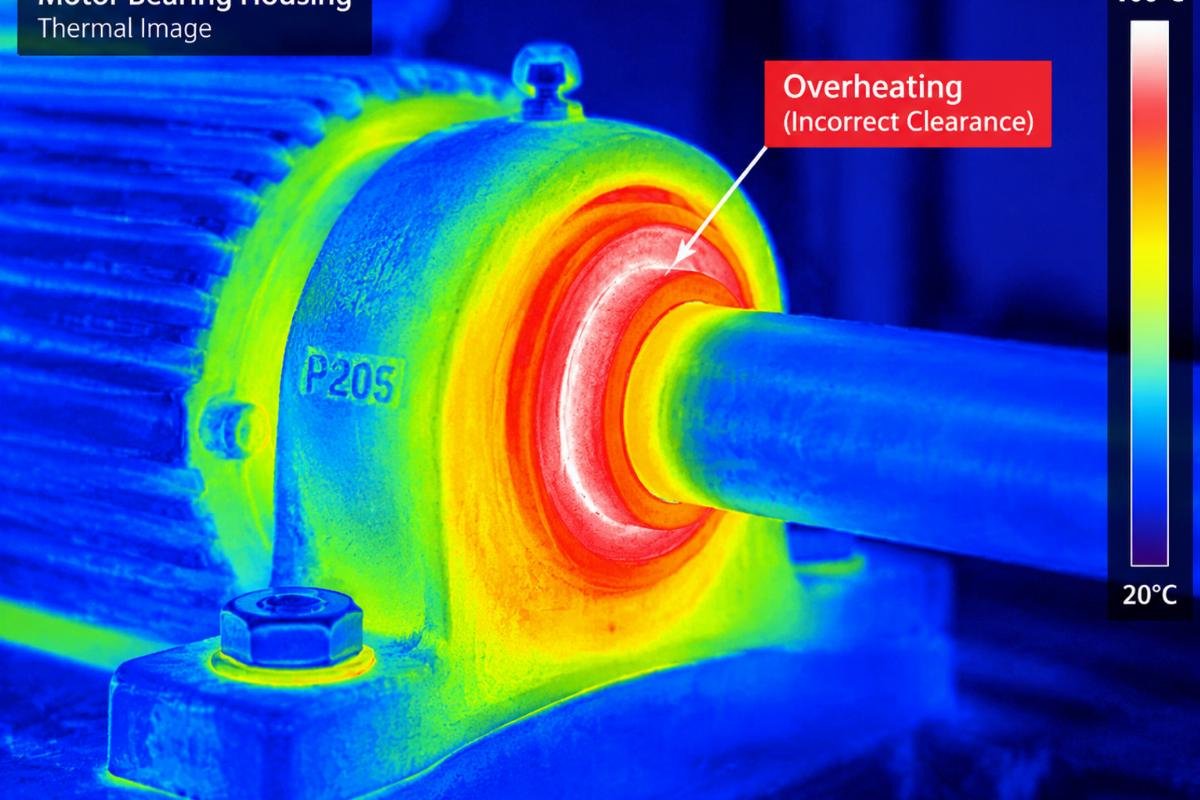
When a bearing has insufficient clearance for its operating environment, the symptoms are distinct. The first sign is often a rise in operating temperature. Infrared thermometers will show the bearing housing running significantly hotter than adjacent components. This heat is friction, generated by the balls being squeezed too tightly.
As the condition worsens, the motor may draw higher current. The increased resistance forces the motor to work harder to maintain speed. Eventually, the bearing seizes. The balls weld to the raceways, and the shaft locks. This type of failure is often mistaken for lubrication failure, but the root cause is geometric incompatibility. [NEED_CITE: ISO 15243 failure mode classification for rolling bearings]
Another sign is unusual noise. A bearing with excessive clearance will produce a rumbling or knocking sound, especially at low speeds. The balls slam into the raceways as they lose contact during rotation. Conversely, a bearing with insufficient clearance may hum at a higher pitch due to the constant preload.
| Symptom | Likely Cause | Action |
|---|---|---|
| High Operating Temp | Insufficient Clearance (C0 in heat) | Replace with C3 |
| Seizure/Lockup | Thermal Expansion Eliminated Clearance | Check Clearance Class |
| Rumbling Noise | Excessive Clearance | Verify Fit and Clearance |
| High Current Draw | Increased Friction from Preload | Inspect Bearing Internals |
For distributors and MRO operators, recognizing these signs helps in diagnosing recurring issues. If a client reports repeated failures in the same motor position, check the clearance specification. It is likely that the original design called for C3, but standard replacements were installed.
Ensuring the correct 6317 deep groove ball bearing size and clearance combination prevents these failures. It is not enough to match the outer dimensions; the internal dynamics must align with the operational reality.
Proper selection extends equipment life and reduces maintenance frequency. It transforms a recurring expense into a reliable asset.
Conclusion
Correct clearance selection is as critical as dimensional accuracy.
The 6317 bearing dimensions of 85x180x48 mm provide the structural foundation for heavy-duty motor applications. However, longevity depends on matching the internal clearance to the thermal environment. C3 clearance is essential for high-temperature operations to prevent seizure. Always verify both size and clearance class before installation to ensure optimal performance and avoid premature failure.