6318 Bearing Specs & Pump Uses: Wholesale Supplier
Tighter clearance is not always better; in hot pumps, it causes thermal seizure.
Selecting a 6318 bearing for pump applications requires matching internal clearance (such as C3) and sealing type to specific operating temperatures and speeds, rather than simply copying standard dimensional drawings. A standard clearance bearing in a high-temperature centrifugal pump will likely fail due to thermal expansion, while an inappropriate seal in a high-speed slurry pump will generate excessive friction heat. The correct specification dep* viscosity, and environmental contamination.

I learned this the hard way early in my procurement career. I ordered a batch of 6318 deep groove ball bearings for a series of centrifugal pumps, strictly following the original equipment manufacturer’s part number without questioning the suffix codes. The bearings arrived with standard internal clearance. Within months, the pumps operating at elevated temperatures began to vibrate excessively and eventually seized. The root cause was not poor quality, but a mismatch between the bearing’s internal space and the thermal expansion of the steel shaft and housing. Now, when I evaluate specifications for clients, I look beyond the basic model number. I examine how the bearing behaves under load and heat. This shift in perspective is critical for anyone sourcing a 6318 bearing for industrial pump systems, where reliability dictates uptime.
What Are the Core Specs of a 6318 Bearing?
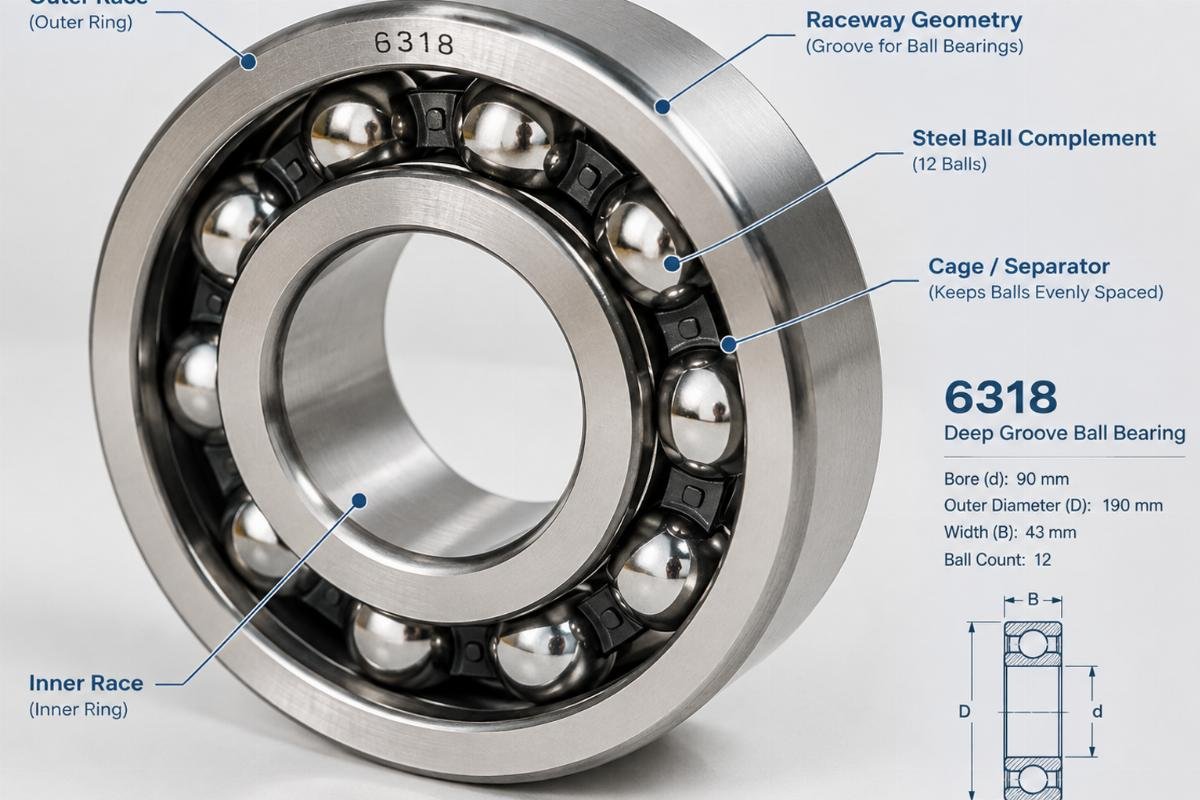
The 6318 is a medium-duty deep groove ball bearing designed for high radial loads and moderate axial loads.
Understanding the baseline specifications is the first step in proper selection. The 6318 designation follows ISO standards, defining its boundary dimensions and basic load ratings. However, these static numbers do not tell the whole story for dynamic pump applications. Buyers often focus solely on the fit, ignoring the speed limits and load capacities that determine service life.
| Parameter | Specification | Note for Pump Applications |
|---|---|---|
| Bore Diameter | 90 mm | Critical for shaft fit tolerance. |
| Outer Diameter | 190 mm | Determines housing bore size. |
| Width | 43 mm | Affects axial space in pump casing. |
| Basic Dynamic Load Rating | High | Suitable for continuous rotational loads. [NEED_CITE: ISO dynamic load rating standards] |
| Basic Static Load Rating | High | Resists shock loads during startup. |
| Limiting Speed (Grease) | Moderate | Depends on cage design and lubricant. |
| Limiting Speed (Oil) | Higher | Allows for better heat dissipation. |
A common mistake is assuming that any brand’s 6318 bearing is interchangeable without checking these underlying parameters. While the dimensions are standardized, the internal geometry, cage material, and steel purity can vary significantly between manufacturers. For a wholesale supplier, verifying that the 6318 bearing meets the required load ratings for specific pump types—such as boiler feed pumps or chemical process pumps—is essential. [NEED_CITE: ABMA standard load rating definitions]
Why Do Standard 6318 Bearings Fail in Hot Pumps?
Standard clearance bearings lack the internal space to accommodate thermal expansion, leading to preload and failure.
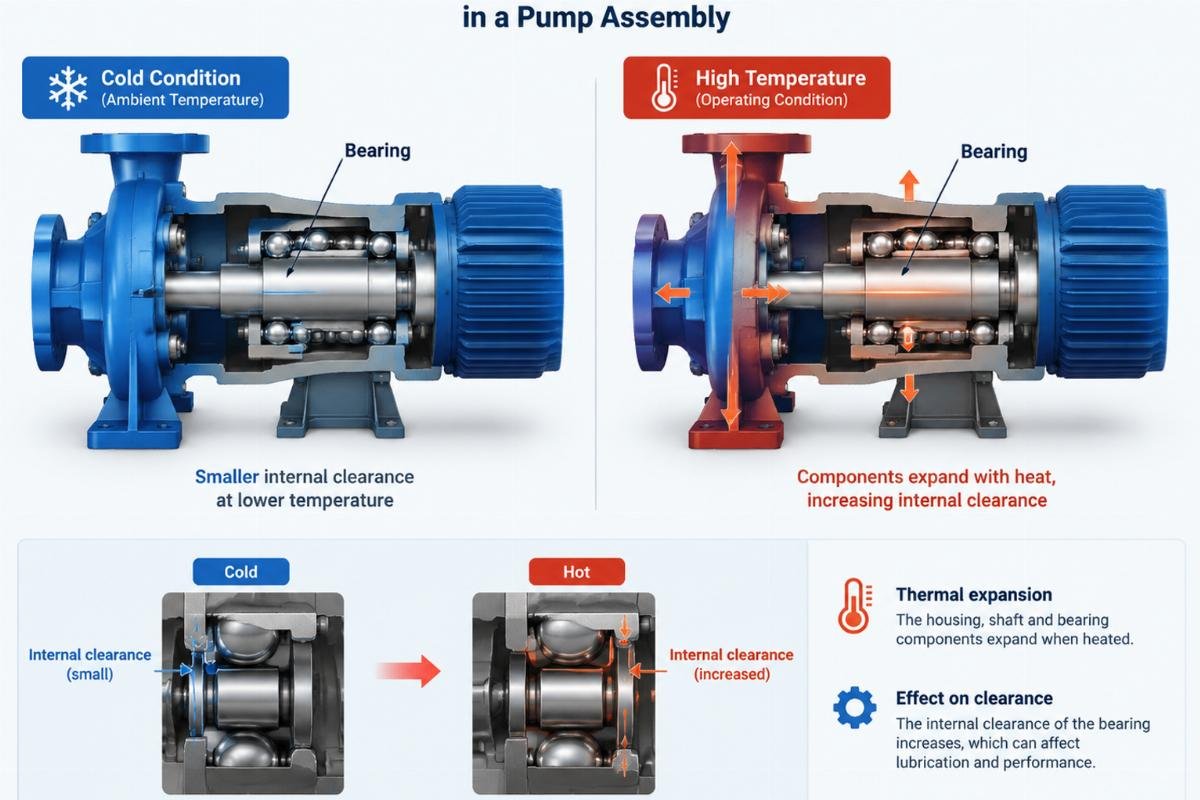
In many industrial pump applications, the operating temperature rises significantly above ambient conditions. Steel expands when heated. If the inner ring expands more than the outer ring, or if the shaft grows faster than the housing, the internal clearance of the bearing decreases. If the initial clearance is standard (C0 or CN), this thermal growth can eliminate the clearance entirely, creating a preloaded condition. This preload generates excessive heat, which further expands the metal, creating a vicious cycle that ends in seizure.
I recall a case involving a European chemical plant where standard 6318 bearings were used in hot oil circulation pumps. The pumps failed repeatedly after short intervals. The maintenance team blamed the lubricant, but the real issue was the clearance group. By switching to a 6318 bearing with C3 clearance, they provided the necessary internal space for thermal expansion. The failures stopped. [NEED_CITE: Thermal expansion coefficients of bearing steel vs. shaft steel]
This is not just about temperature; it is about the differential expansion between components. In a pump, the shaft is often exposed to the hot fluid, while the housing may be cooled by air or water. This gradient creates complex stress patterns within the bearing. A wholesale supplier must understand these dynamics to recommend the correct 6318 bearing variant. Simply supplying a “standard” unit without discussing operating temperature is a recipe for premature failure.
C3 vs Standard Clearance: Which Fits Your Pump?
C3 clearance is generally preferred for pumps operating above 70°C or with tight shaft fits.
Choosing between standard (CN) and C3 clearance is one of the most critical decisions in pump bearing selection. C3 clearance offers greater internal space between the balls and raceways. This extra space accommodates thermal expansion and compensates for slight misalignments or interference fits that might otherwise reduce clearance.
| Feature | Standard Clearance (CN) | C3 Clearance |
|---|---|---|
| Internal Space | Minimal | Increased |
| Thermal Tolerance | Low | High |
| Noise Level | Lower | Slightly Higher |
| Vibration Sensitivity | Lower | Higher |
| Best Use Case | Ambient temperature, loose fits | High temperature, tight fits |
For a buyer sourcing a 6318 bearing, the choice depends on the pump’s operating environment. In a cool water pump running at ambient temperature, standard clearance might suffice and offer quieter operation. However, in a steam condensate pump or a high-temperature process pump, C3 is almost mandatory. The slight increase in noise associated with C3 clearance is a negligible trade-off for the significant gain in reliability and lifespan. [NEED_CITE: ISO clearance group definitions]
We maintain a robust inventory of 6318 bearings in both standard and C3 clearance groups from multiple premium brands. This allows us to provide cross-brand equivalents quickly, ensuring that our clients can find the right technical solution without waiting for special orders. Whether you need SKF, FAG, or NSK variants, having access to a multi-brand stock of 6318 C3 bearings ensures that your pump maintenance schedule stays on track.

Sealing Options: ZZ vs 2RS for Pump Environments
Metal shields (ZZ) reduce friction at high speeds, while rubber seals (2RS) offer superior contamination protection.
The suffix of a 6318 bearing indicates its sealing configuration, which directly impacts performance in pump applications. The two most common options are ZZ (metal shields) and 2RS (rubber contact seals). Each has distinct advantages and limitations that must be matched to the pump’s operating conditions.
ZZ shields are non-contacting metal plates that keep large contaminants out while allowing some airflow. They generate minimal friction, making them ideal for high-speed pumps where heat buildup is a concern. However, they do not provide a complete barrier against moisture or fine dust. In contrast, 2RS seals are made of rubber and make contact with the inner ring. They offer excellent protection against water, slurry, and fine particles, which is crucial for pumps in dirty or wet environments. The trade-off is higher friction, which can limit maximum speed and generate more heat.
| Feature | ZZ (Metal Shield) | 2RS (Rubber Seal) |
|---|---|---|
| Friction | Low | High |
| Speed Limit | High | Moderate |
| Contamination Protection | Basic | Superior |
| Moisture Resistance | Low | High |
| Best Environment | Clean, high-speed | Dirty, wet, low-to-moderate speed |
I once advised a client in the mining sector who was using 2RS sealed 6318 bearings in high-speed slurry pumps. The bearings were overheating due to the friction from the rubber seals. Switching to ZZ shields, combined with an external labyrinth seal on the pump shaft, solved the heat issue while still protecting the bearing from large debris. This example highlights why a one-size-fits-all approach to sealing fails. [NEED_CITE: Friction torque characteristics of bearing seals]
As a global supplier, we stock both ZZ and 2RS versions of the 6318 bearing across major brands. Our technical team helps buyers analyze their specific pump environment—considering factors like speed, contamination level, and lubrication method—to select the optimal sealing type. This consultative approach ensures that the 6318 bearing you purchase is not just a spare part, but a optimized component for your specific application.

Conclusion
Selecting the right 6318 bearing requires balancing clearance, sealing, and operating conditions.
Do not rely solely on the base model number. Consider the thermal environment to choose between standard and C3 clearance, and evaluate the contamination risk to decide between ZZ and 2RS seals. Proper specification prevents premature failure and optimizes pump lifespan.