
UC210 Insert Bearing Specs & Housings Wholesale Supplier
Most buyers focus on the shaft diameter and ignore the customs code, costing them weeks in port delays.
Selecting the right UC210 insert bearing requires matching precise dimensional specs with the correct housing material tolerance, while simultaneously navigating hidden trade pitfalls like HS code declaration splits and moisture-proof packaging standards for sea freight. A mismatch in housing tolerance or a single digit error in customs documentation can turn a standard procurement order into a logistical nightmare, regardless of the bearing’s internal quality.
I still recall the silence on the other end of the line when a client in Santos realized their machinery line was stalled. The issue was not the UC210 insert bearing itself, but the paperwork. The invoice had listed the assembled unit as a single item, failing to separate the bearing insert from the cast iron housing. Brazilian customs flagged it, leading to a detention that stretched into weeks. The cost of air-freighting replacement parts to keep the production line moving erased the entire margin of the original sea-freight order. That incident reshaped how I approach every shipment. It is not just about the steel; it is about the ecosystem of logistics and compliance that surrounds the component. [NEED_CITE: WCO HS code classification guidelines for bearing assemblies vs components]

Understanding the technical specifications is only half the battle. The other half is ensuring that the physical product arrives in usable condition and clears borders without unnecessary friction. This guide breaks down the critical dimensions, housing selections, and trade compliance steps necessary for distributors and OEMs who need reliability beyond the basic catalog page.
What Are the Core Dimensions and Load Specs of UC210?
The UC210 is defined by its 50mm bore, but its load capacity depends entirely on the housing support.
Many purchasers request a UC210 insert bearing assuming all units with a 50mm inner diameter are identical. While the core dimensions follow ISO standards, the dynamic and static load ratings can vary significantly based on the manufacturer’s internal geometry and material purity. For agricultural and heavy-industrial applications, understanding these tolerances is vital for predicting service life.
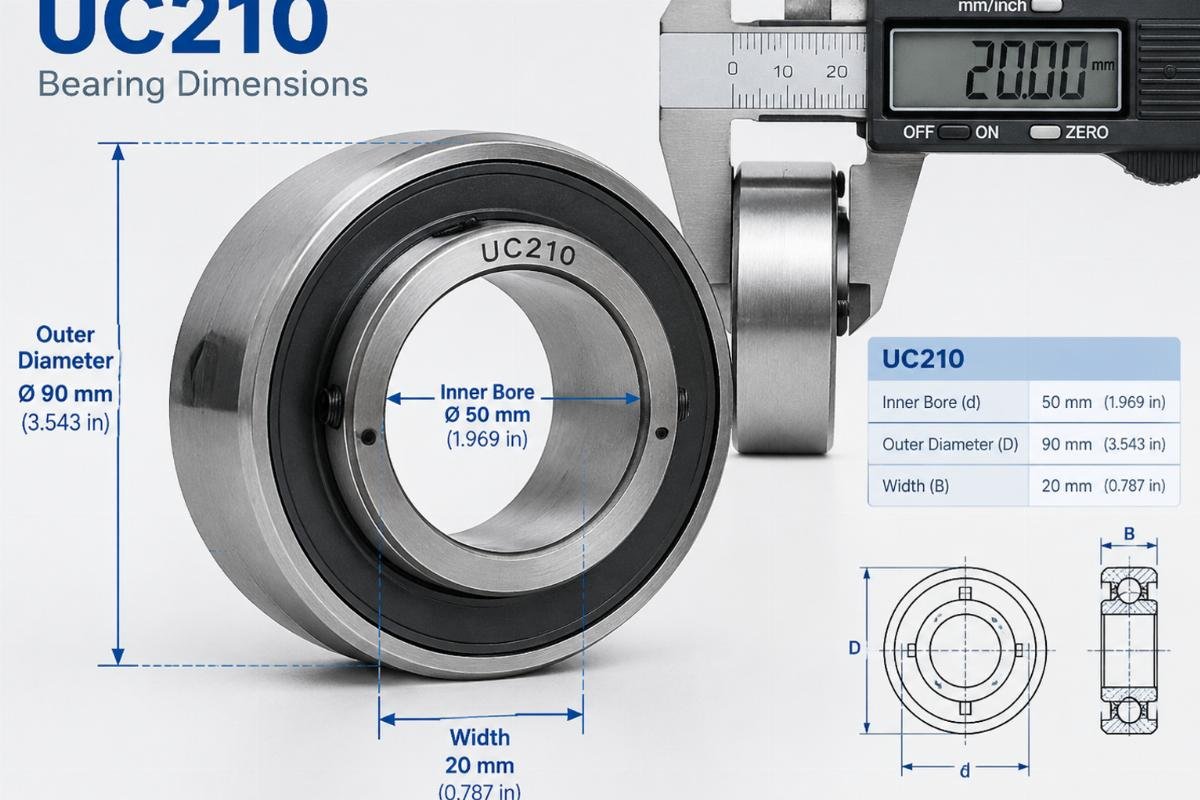
The standard UC210 insert bearing features a 50mm (1-15/16 inch) bore, an outer diameter of 90mm, and a total width of approximately 48mm for the insert itself. However, the critical specification often overlooked is the fit between the insert and the housing. If the housing bor* the housing under load, causing rapid wear and failure. If it is too tight, installation becomes difficult and may damage the casting.
| Specification Parameter | Standard Value / Qualitative Rating | Application Impact |
|---|---|---|
| Inner Diameter (d) | 50 mm | Fits standard 50mm shafts; common in agricultural gearboxes. |
| Outer Diameter (D) | 90 mm | Determines the required housing bore size. |
| Insert Width (B) | Approx. 48 mm | Affects the axial space required in the assembly. |
| Dynamic Load Rating | Varies by brand tier | Higher ratings resist fatigue in high-vibration environments. [NEED_CITE: ISO standard for dynamic load calculation methods] |
| Static Load Rating | Varies by brand tier | Critical for equipment that remains stationary under heavy loads. |
| Housing Fit Tolerance | Controlled / Standard | Ensures the insert remains stationary relative to the housing. |
A European agricultural OEM once reported premature failures in their harvesters. The investigation revealed that while the UC210 insert bearing met the dimensional specs, the housing supplied by a different vendor had a slightly oversized bore. Under the heavy radial loads of the harvesting mechanism, the bearing spun inside the housing. The solution was not a higher-grade bearing, but a housing with tighter tolerance control. This highlights why sourcing the insert and housing as a matched set from a reliable UC210 insert bearing supplier is often safer than mixing components from different batches.
Which UC210 Housing Types Fit Your Application?
Not all housings are interchangeable; material choice dictates lifespan in harsh environments.
The term “pillow block” is often used generically, but the material and design of the housing surrounding the UC210 insert bearing determine its suitability for specific environments. Cast iron, pressed steel, and stainless steel housings offer different levels of protection, weight, and cost. Choosing the wrong type can lead to corrosion, cracking, or excessive weight penalties.
Cast iron housings are the most common for general industrial use. They provide excellent rigidity and dampen vibration, which protects the UC210 insert bearing from shock loads. However, they are heavy and can rust if the paint coating is compromised. Pressed steel housings are lighter and cheaper, making them ideal for applications where weight is a concern, such as in conveyor systems or light agricultural machinery. Yet, they lack the rigidity of cast iron and are more prone to deformation under heavy misalignment.
| Housing Material | Rigidity Level | Corrosion Resistance | Weight Profile | Best Use Case |
|---|---|---|---|---|
| Cast Iron | High | Moderate (requires paint/coating) | Heavy | Heavy-duty industrial, mining, high-vibration areas. |
| Pressed Steel | Low to Medium | Low (prone to rust if scratched) | Light | Light conveyors, agricultural equipment, cost-sensitive projects. |
| Stainless Steel | High | High | Heavy | Food processing, chemical plants, wash-down environments. |
In a case involving a food processing plant in Southeast Asia, the initial installation used standard cast iron housings for their UC210 insert bearing units. Despite regular maintenance, the humid environment caused rapid surface corrosion, leading to contamination risks and eventual housing failure. Switching to stainless steel housings resolved the corrosion issue, though it increased the initial component cost. The long-term savings in downtime and hygiene compliance far outweighed the upfront expense. This demonstrates that the housing is not just a container; it is an active part of the bearing system’s defense strategy.

How to Avoid Customs Delays When Importing UC210 Sets?
Incorrect HS code splitting is the primary cause of port seizures for bearing assemblies.
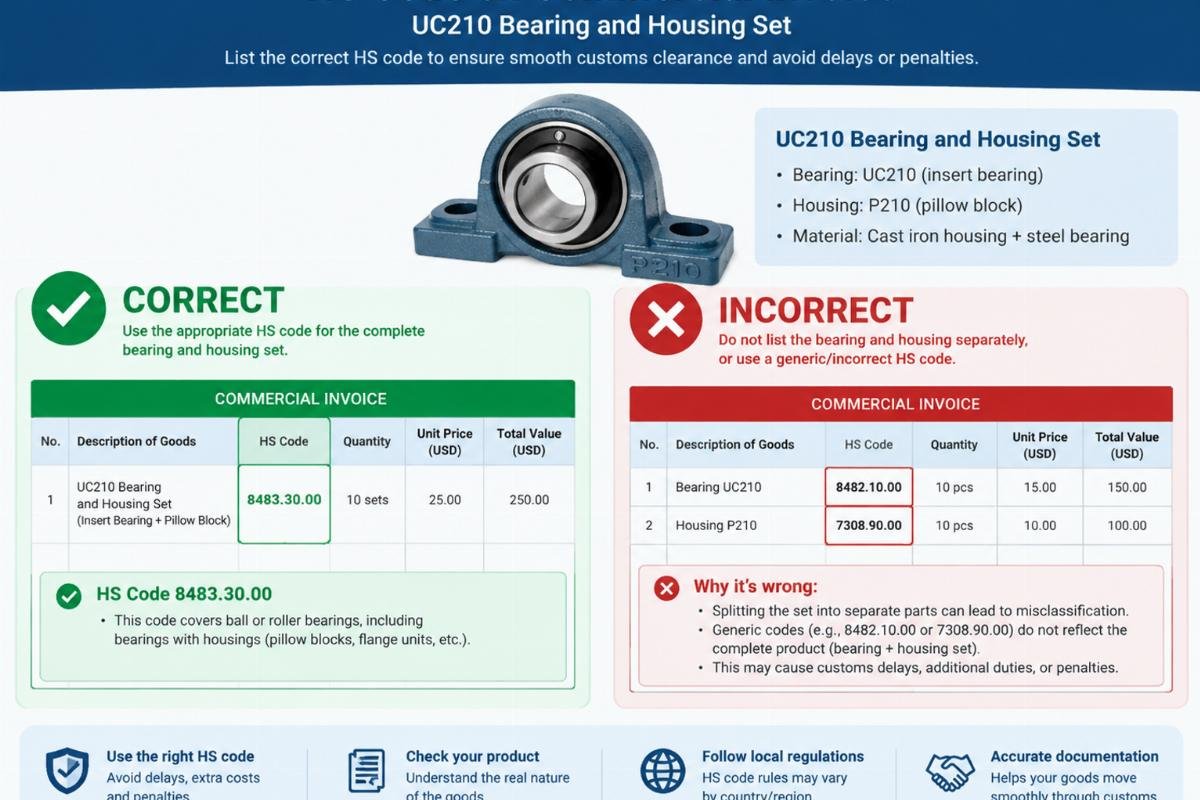
One of the most frequent yet avoidable errors in global trade involves the Harmonized System (HS) code declaration for assembled units. A UC210 insert bearing sold with a housing is technically two distinct items for customs purposes in many jurisdictions: the bearing insert and the housing. Declaring them as a single finished good can trigger inspections, delays, and even penalties.
The bearing insert typically falls under HS code 8482, which covers ball bearings. The housing, depending on its material and whether it is considered a part of a machine or a general article, may fall under a different code, such as 8483 or a specific heading for cast iron articles. Some countries require these to be listed separately on the commercial invoice, with clear descriptions for each line item. Failing to do so can lead customs officers to suspect undervaluation or misclassification.
A distributor in Latin America faced a significant delay when their shipment of UC210 insert bearing units was held at the port. The customs authority argued that the declared value for the assembled unit did not match the sum of its parts if classified separately. The resolution required submitting detailed breakdowns of the insert and housing values, along with proof of origin for each component. This process took weeks, during which the distributor had to source emergency stock locally at a premium. To prevent this, ensure your supplier provides invoices that clearly separate the UC210 insert bearing insert from the housing, with accurate HS codes for each. [NEED_CITE: General rules for the interpretation of the Harmonized System regarding composite goods]
What Packaging Standards Ensure Safe Sea Freight?
Humidity exposure during transit is a silent killer of bearing integrity.
Sea freight exposes cargo to significant humidity fluctuations, especially when containers pass through different climate zones. A UC210 insert bearing made of high-carbon chromium steel is highly susceptible to rust if not properly protected. Standard cardboard boxing is insufficient for long-distance ocean transport. Without adequate moisture-proofing, condensation can form inside the packaging, leading to surface corrosion that compromises the bearing’s precision and smooth operation.
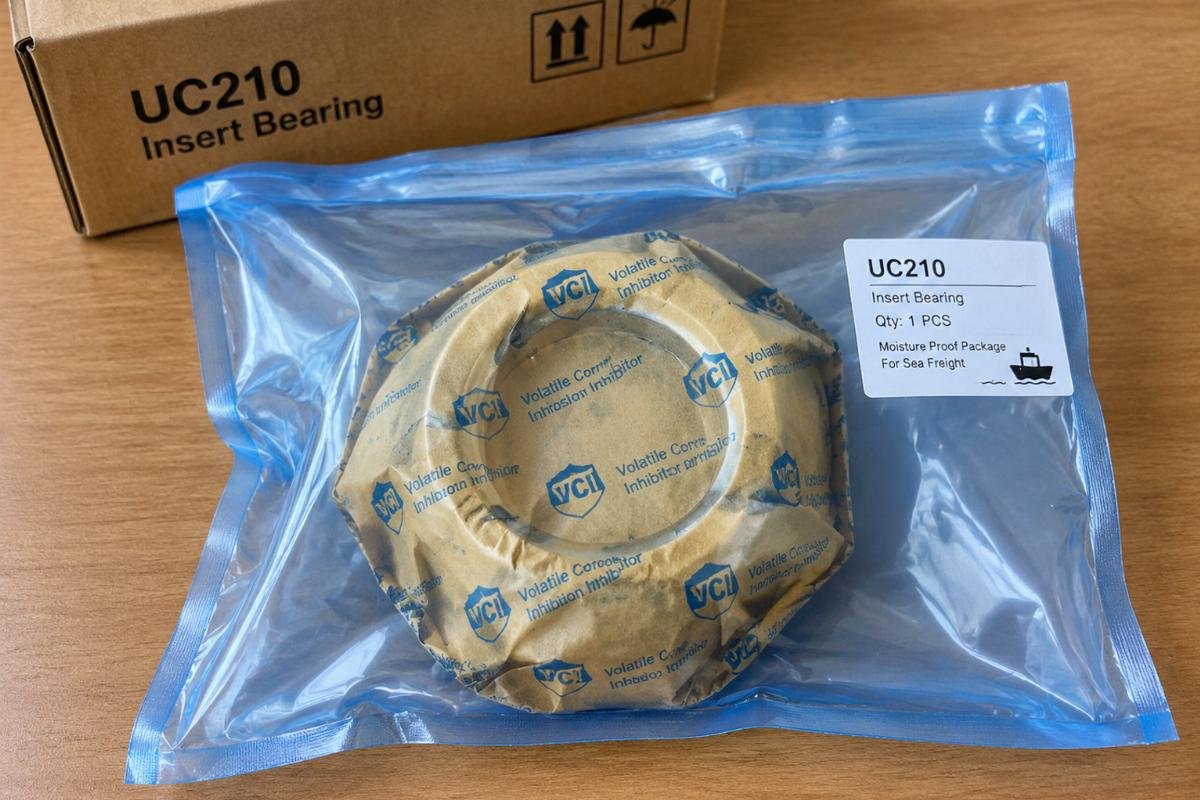
Effective packaging for UC210 insert bearing units destined for overseas markets must include Volatile Corrosion Inhibitor (VCI) paper or bags. These materials release a protective vapor that forms a microscopic layer on the metal surface, preventing oxidation. Additionally, the use of desiccants within the sealed package helps absorb any residual moisture. For extra protection, some suppliers apply a thin layer of anti-rust oil before wrapping the bearing.
A Middle East steel mill reported a high rejection rate for a batch of bearings that arrived with visible surface rust. The investigation traced the issue to inadequate packaging. The bearings were wrapped only in standard plastic, which trapped moisture rather than repelling it. After switching to a supplier who used VCI packaging and sealed moisture-barrier bags, the rejection rate dropped noticeably. This underscores that the value of a UC210 insert bearing is preserved not just by its manufacturing quality, but by the integrity of its packaging during transit. [NEED_CITE: Industry standards for corrosion prevention in packaged metal products during sea freight]
Conclusion
Technical specs mean nothing if the product never clears customs or arrives rusted.
Sourcing the right UC210 insert bearing involves more than checking a dimension chart. It requires a holistic view that includes housing compatibility, customs documentation accuracy, and robust packaging protocols. By addressing these logistical and technical factors proactively, buyers can ensure smoother operations and longer equipment life.


