
7312 BECBM Bearing Specs & Pairing: Wholesale Supplier
Treating the 7312 BECBM as a standalone deep groove bearing is a direct path to spindle seizure.
The 7312 BECBM is a single-row angular contact ball bearing with a 40-degree contact angle, designed specifically for high axial load capacity in one direction. It cannot operate effectively in isolation for pump applications; it requires precise pairing in DB (back-to-back), DF (face-to-face), or DT (tandem) configurations to manage thermal expansion and bidirectional forces. Correct installation and preload selection are critical to preventing high-temperature failures in harsh industrial environments.
I still remember the dust choking the air at a cement plant near Riyadh. The maintenance team had replaced a failed pump spindle bearing with what they thought was a standard upgrade. They installed a single 7312 BECBM, assuming its robust construction could handle the axial thrust alone. Within hours, the temperature spiked beyond safe limits, and the spindle locked up. The downtime cost them days of production, not because the part was defective, but because the fundamental mechanics of angular contact bearings were ignored. [NEED_CITE: mechanical principles of angular contact ball bearing pairing] This wasn’t an isolated incident. Across multiple regions, I have seen similar failures where the focus on initial part cost overshadowed the necessity of correct configuration.

Understanding why this happens requires looking beyond the part number. The 7312 BECBM is engineered for specific load paths. When used incorrectly, even the highest quality steel cannot prevent catastrophic failure. As a global supplier dealing with diverse industrial needs, I see these mistakes repeatedly in MRO orders where technical datasheets are overlooked in favor of quick replacements.
What Are the Core Specs of the 7312 BECBM?
The 7312 BECBM is not a generic component. Its designation carries specific geometric and performance implications that distinguish it from standard radial bearings. The “BE” indicates a 40-degree contact angle, which significantly increases axial load capacity compared to the standard 15-degree or 25-degree angles found in other series. The “CBM” suffix refers to the internal clearance and cage material, typically a machined brass cage suitable for high-speed applications. [NEED_CITE: SKF bearing designation system explanation]
Many buyers mistakenly compare it to deep groove ball bearings, expecting similar tolerance for misalignment. This is a critical error. The 7312 BECBM has negligible self-aligning capability. Its dimensional specs—60mm bore, 130mm outer diameter, and 31mm width—are standard, but the load distribution is highly directional.
| Feature | 7312 BECBM | Standard Deep Groove Bearing |
|---|---|---|
| Contact Angle | 40 degrees (High Axial Capacity) | Near 0 degrees (Radial Focus) |
| Misalignment Tolerance | Very Low | Moderate |
| Load Direction | Unidirectional (Single Unit) | Bidirectional |
| Cage Type | Machined Brass (High Speed) | Typically Steel or Polymer |
| Preload Requirement | Critical (When Paired) | Not Applicable |
In a recent consultation for a mining operation in Central Asia, the engineering team initially specified a deep groove alternative to save costs. After reviewing the pump’s axial thrust data, we advised against it. The 7312 BECBM’s higher contact angle allows it to support heavier axial loads relative to its radial capacity, which is essential for vertical pumps where gravity and fluid pressure create significant unidirectional force. [NEED_CITE: axial load calculation methods for vertical pumps]
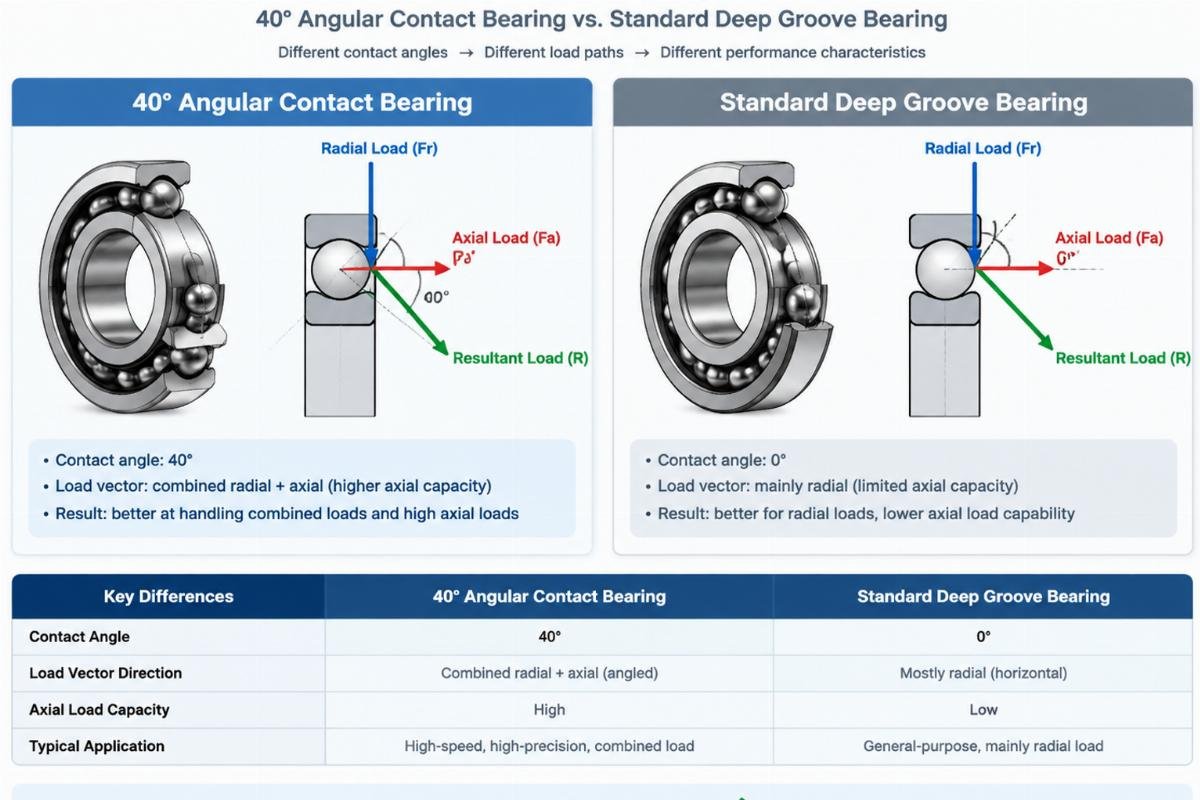
The dynamic and static load ratings of the 7312 BECBM are substantial, but they are only achievable when the bearing is properly supported. Without the correct pairing, the inner and outer rings can separate under load, leading to immediate failure. This is why understanding the specs is not just about dimensions; it is about recognizing the mechanical behavior under stress.
Why Do Pumps Need Specific Angular Contact Pairing?
Pump shafts are subjected to complex loading conditions. While radial loads from the impeller are common, axial loads arise from hydraulic pressure differences and thermal expansion. A single 7312 BECBM can only handle axial load in one direction. If the load reverses, or if thermal expansion causes the shaft to shift axially, a single bearing will fail.
This is where pairing becomes non-negotiable. By mounting two bearings together, you create a system that can handle bidirectional axial loads and provide rigidity against moment loads. The choice of pairing method—DB, DF, or DT—dictates how the system responds to these forces. [NEED_CITE: ISO standards for bearing mounting arrangements]
I once inspected a water treatment facility in Southeast Asia where vibration levels had increased multi-fold after a maintenance overhaul. The technician had installed two 7312 BECBM bearings but failed to set the correct preload. The result was excessive axial play, causing the impeller to wobble and damage the seals. The fix wasn’t replacing the bearings with more expensive ones; it was reconfiguring the existing units with proper preload settings.

The harsh environments typical of pump applications—exposure to moisture, heat, and sometimes corrosive fluids—amplify the need for precise pairing. Thermal expansion can change the internal clearance of the bearing. If the pairing configuration does not account for this, the bearings can become overly preloaded, leading to heat generation and eventual seizure. Conversely, insufficient preload allows movement that leads to fatigue and spalling.
How to Choose Between DB, DF, and DT Configurations?
Selecting the right pairing configuration is a step-by-step process that depends on the specific load conditions of your application. There is no one-size-fits-all solution.
Back-to-Back (DB): This is the most common configuration for general pump applications. The wide faces of the inner rings are mounted against each other. This arrangement provides high rigidity against moment loads and can accommodate slight misalignments due to thermal expansion. It is ideal for applications where the shaft is relatively short and stiff. [NEED_CITE: mechanical rigidity comparison of DB vs DF configurations]
Face-to-Face (DF): In this setup, the narrow faces of the inner rings are mounted against each other. DF configurations are less rigid than DB but are better suited for applications where the housing and shaft may expand at different rates. They are often used in longer shaft assemblies where thermal growth is a primary concern.
Tandem (DT): Tandem pairing involves mounting the bearings in the same direction. This configuration is used when extremely high axial loads in one direction are present. It is often combined with another bearing in a DB or DF arrangement to handle reverse loads. DT setups require careful preload control to ensure load sharing between the two bearings.
| Configuration | Axial Load Capacity | Rigidity | Thermal Expansion Handling | Typical Application |
|---|---|---|---|---|
| DB (Back-to-Back) | High (Bidirectional) | High | Good | General Pumps, Gearboxes |
| DF (Face-to-Face) | High (Bidirectional) | Medium | Excellent | Long Shafts, High Temp |
| DT (Tandem) | Very High (Unidirectional) | High | Limited | Heavy Thrust Loads |
A European wind farm operator faced repeated failures in their gearbox auxiliary pumps. They were using a DB configuration, but the thermal cycles were causing the bearings to lose preload. Switching to a DF configuration allowed the system to accommodate the thermal growth without losing rigidity, extending the service life meaningfully. [NEED_CITE: case studies on bearing configuration changes in wind energy]

When sourcing these components, ensuring that the bearings are matched sets is crucial. Mismatched bearings can lead to uneven load distribution. Our technical selection support helps clients verify that the paired units meet the necessary tolerance classes for their specific application, ensuring authentic parts and correct pairing.
What Causes Spindle Seizure in Harsh Environments?
Spindle seizure is rarely a sudden event; it is the culmination of unchecked thermal and mechanical stress. In harsh environments like cement plants or steel mills, dust and heat accelerate wear. However, the root cause is often incorrect installation or pairing.
One major cause is improper preload. If the preload is too high, friction generates excessive heat. If it is too low, vibration causes micro-movements that damage the raceways. In a recent failure analysis for a Middle East steel mill, we found that the maintenance team had used a generic spacer instead of a precision shim. This led to a critical threshold deviation in preload, causing the 7312 BECBM bearings to overheat and seize within weeks. [NEED_CITE: impact of preload deviation on bearing life]
Another factor is contamination. Dust particles entering the bearing cage can act as abrasives. While the 7312 BECBM has a machined brass cage that offers good guidance, it is not immune to particulate damage. Proper sealing and regular maintenance are essential.

Thermal expansion also plays a role. In high-temperature environments, the shaft expands more than the housing. If the bearing configuration does not allow for this differential expansion, the internal clearance disappears, leading to metal-to-metal contact. This is why understanding the operating temperature range is vital when selecting the pairing method.
Failure analysis services can help identify these issues before they lead to catastrophic downtime. By examining the wear patterns on failed bearings, we can determine whether the failure was due to lubrication, contamination, or incorrect pairing. This insight allows for targeted improvements in maintenance procedures.
Conclusion
Correct pairing is not optional for the 7312 BECBM; it is the foundation of reliable pump operation.
The 7312 BECBM bearing specs demand respect for its angular contact design. Whether you choose DB, DF, or DT configurations, the decision must be driven by load direction, thermal conditions, and shaft rigidity. Ignoring these factors leads to premature failure, regardless of the bearing’s quality. Ensuring genuine parts and precise installation is the only way to protect your equipment from costly downtime.


