7314 Angular Contact Bearing for Pump: Wholesale Supplier
The cheapest 7314 angular contact bearing is often the most expensive component in your pump maintenance budget.
A 7314 angular contact bearing for pumps is not a generic commodity; it is a precision-engineered solution designed to handle combined radial and axial loads in high-stress fluid handling systems. Its operational lifespan depends less on the initial purchase price and more on precise matching of contact angles, cage materials, and lubrication protocols to specific working conditions. Premature failure typically stems from lubrication starvation or misaligned operating parameters rather than inherent manufacturing defects.
I still remember the humid air inside a gold ore processing plant in Nigeria. The site manager was furious. A critical slurry pump had seized up after only a few weeks of operation. The culprit was a batch of non-branded 7314 angular contact bearings chosen solely for their low cost. Under the high temperature and heavy load typical of mud pump operations, the bearing cages had fragmented. The resulting downtime paralyzed the entire production line for several days. I had to arrange emergency air freight for genuine SKF and ZWZ replacements to restore operations. That incident reinforced a hard truth: in pump applications, technical suitability outweighs unit price every time. [NEED_CITE: common failure modes in slurry pump bearings per ISO 15243]

Understanding why these components fail requires looking beyond the part number. It demands a deep dive into the mechanical realities of pump dynamics.
What Are the Core Uses of 7314 Bearings in Pumps?
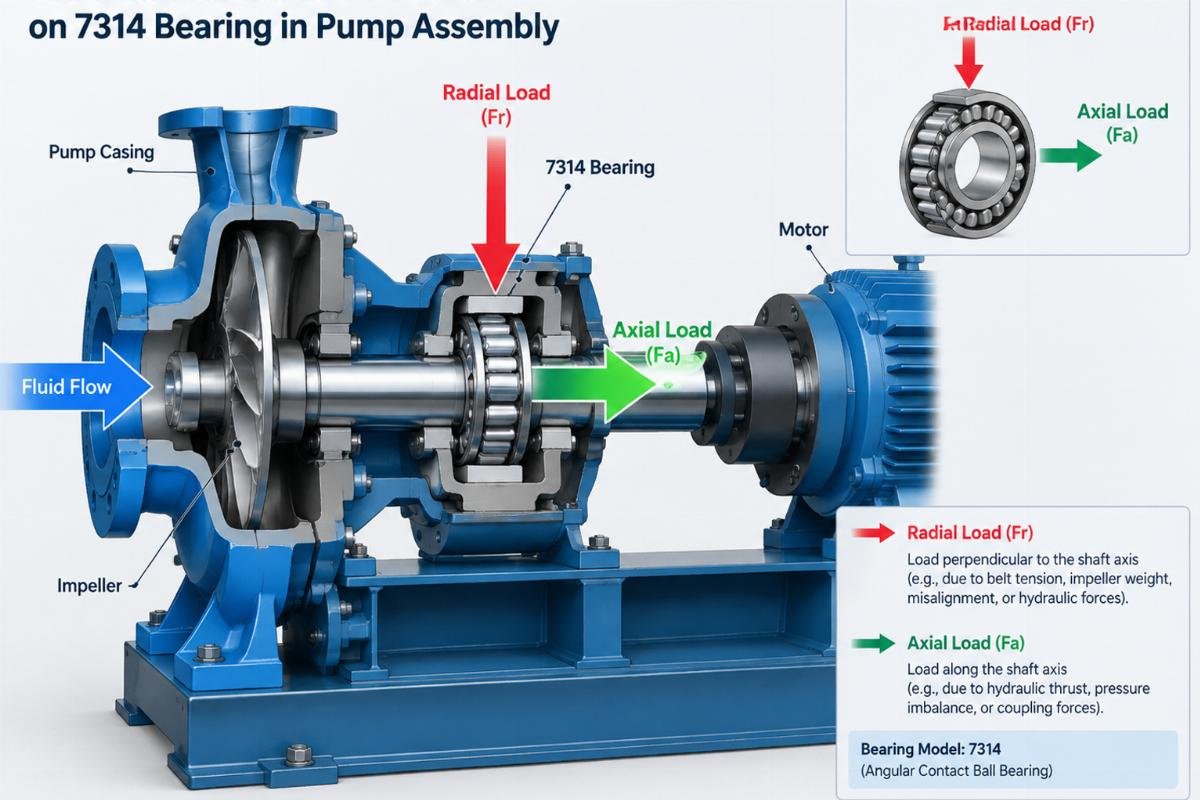
7314 bearings are specifically engineered to manage simultaneous radial and axial forces, making them indispensable in centrifugal and slurry pump designs.
In many industrial pumps, the impeller generates significant axial thrust alongside radial load. Standard deep groove ball bearings cannot adequately handle this combined stress. The 7314 angular contact bearing features a contact angle that allows it to support higher axial loads in one direction. This makes it ideal for single-stage centrifugal pumps where hydraulic balance is not perfect. [NEED_CITE: axial load capacity calculations for angular contact ball bearings]
For heavy-duty applications like mud pumps, the demands are even greater. These pumps operate in abrasive environments with fluctuating loads. A 7314 bearing in such a setup must resist contamination and maintain structural integrity under shock loading. The choice between a standard steel cage and a brass or polymer cage can determine whether the bearing survives the harsh conditions.
| Application Type | Primary Load Challenge | Recommended Cage Material | Lubrication Requirement |
|---|---|---|---|
| Centrifugal Water Pump | Moderate Axial + Radial | Steel or Polyamide | Standard Grease |
| Slurry/Mud Pump | High Shock + Abrasion | Brass or Reinforced Polymer | Heavy-Duty EP Grease |
| High-Temperature Process Pump | Thermal Expansion + Load | Steel with Special Heat Treatment | High-Temp Synthetic Oil |
When sourcing a 7314 angular contact bearing for pumps, distributors must verify that the internal clearance matches the pump’s thermal expansion characteristics. Using a standard clearance in a high-temperature environment can lead to preload issues and rapid overheating.
Why Do 7314 Bearings Fail Prematurely in Pump Applications?
Most premature failures are misdiagnosed as quality issues when they are actually symptoms of lubrication starvation or incorrect operating conditions.
It is counter-intuitive, but a high-quality bearing will fail quickly if the application environment is ignored. In the Nigerian case, the fragmentation of the cage was not due to weak material alone. It was exacerbated by inadequate lubrication intervals and excessive heat buildup. Blackened oil found during the teardown indicated severe overheating, a classic sign of lubrication mismatch rather than a manufacturing defect. [NEED_CITE: lubrication failure analysis in industrial rotating equipment]
Another common cause is misalignment. If the pump shaft and housing are not perfectly aligned, the 7314 bearing experiences uneven load distribution. This creates stress concentrations that lead to early fatigue spalling. Operators often overlook soft foot or pipe strain, blaming the bearing instead.
| Failure Symptom | Likely Root Cause | Corrective Action |
|---|---|---|
| Cage Fragmentation | Overheating/Lubrication Starvation | Review lubrication schedule and type |
| Inner Ring Cracking | Excessive Interference Fit | Check housing tolerances and fit class |
| Rolling Element Spalling | Misalignment or Contamination | Verify shaft alignment and sealing effectiveness |
| Discoloration (Blue/Brown) | High Temperature Operation | Improve cooling or switch to high-temp lubricant |
Sourcing a reliable 7314 angular contact bearing for pumps involves more than checking dimensions. It requires understanding the specific failure history of the equipment. A supplier who asks about your operating temperature and load profile is providing value beyond just logistics.

How to Select the Right 7314 Bearing for Your Pump?
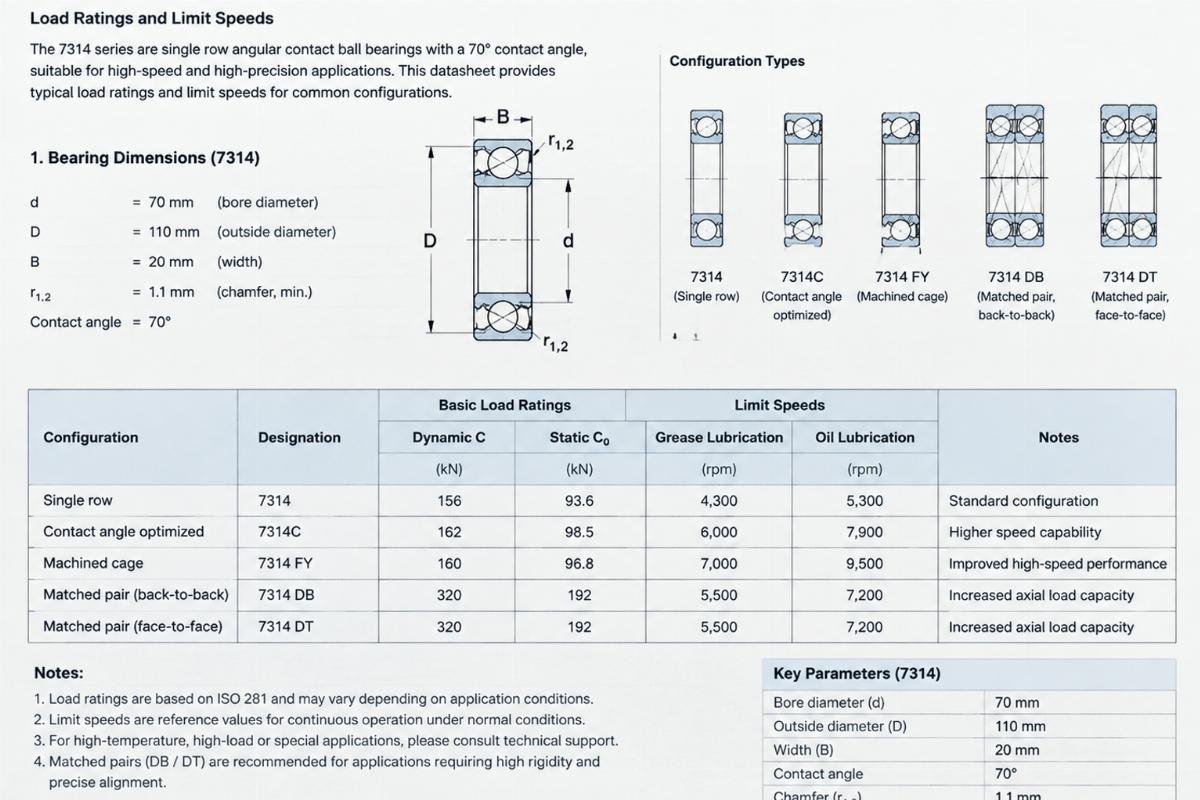
Selection must be driven by technical data including contact angle, limit speeds, and load ratings, not just brand availability.
Not all 7314 bearings are identical. The suffixes matter. A 7314 BECBP differs significantly from a 7314 ACD in terms of contact angle and internal design. For pump applications, the contact angle determines the axial load capacity. A larger angle supports more axial load but may reduce radial capacity. [NEED_CITE: ISO standards for angular contact ball bearing dimensional series]
Limit speed is another critical factor. Pumps operating at high RPMs generate more heat. Grease-lubricated bearings have lower limit speeds than oil-lubricated ones. Choosing a bearing designed for grease lubrication in an oil-fed system, or vice versa, can lead to inefficiency and failure.
When evaluating options, consider the cage material. Steel cages are robust but heavier. Polymer cages offer better damping and lighter weight but may have temperature limits. For mud pumps, brass cages are often preferred for their strength and resistance to debris.
A professional supplier will provide traceability documentation and technical datasheets to ensure the selected 7314 angular contact bearing for pumps matches the OEM specifications. This prevents the costly mistake of installing a physically compatible but functionally inadequate component.
What Are the Best Practices for Pump Bearing Maintenance?
Strict adherence to lubrication schedules and vibration monitoring is the most effective strategy to prevent unplanned downtime.
Maintenance is where the theoretical life of a bearing meets reality. Even the best 7314 angular contact bearing for pumps will fail if neglected. Regular vibration analysis can detect misalignment or imbalance before catastrophic failure occurs. Sudden changes in vibration signature often precede visible damage.
Lubrication must be precise. Over-greasing is as harmful as under-greasing. Excess grease causes churning and heat buildup. Use calculated intervals based on operating hours and temperature. For critical pumps, consider automated lubrication systems to ensure consistency.
Storage also matters. Bearings sitting in warehouses for extended periods can suffer from false brinelling if not rotated periodically. Ensure stock is stored in controlled environments. When sourcing replacements, prioritize suppliers with massive spot inventory to minimize storage time and ensure freshness.

Conclusion
Reliability in pump operations starts with the right bearing selection and ends with disciplined maintenance.
The 7314 angular contact bearing for pumps is a critical component that demands respect for its technical specifications. By focusing on proper load matching, lubrication, and condition monitoring, operators can avoid the hidden costs of premature failure. Sourcing from a partner who understands these technical nuances ensures that your supply chain supports, rather than hinders, your operational efficiency.