
Lubrication Program Setup for a Plant: Bulk Bearing Supplier
More grease does not mean better protection. In heavy industry, over-lubrication is a leading cause of premature bearing failure, often causing more damage than under-lubrication. A successful plant lubrication program relies on site-specific condition assessments rather than rigid manual schedules to prevent these failures. It requires matching grease dropping points to ambient heat, calculating exact cavity fill ratios, and adjusting intervals based on real-time temperature and load data.

I learned this the hard way in an Indonesian nickel mine. The crusher’s spherical roller bearings were failing every few months. We followed the manual strictly, adding grease at fixed intervals. The bearings didn’t wear out; they cooked from the inside. The excess grease churned, generating heat that degraded the lubricant and destroyed the cage. That loss was not just about the cost of a new bearing; it was the mid-six-figure loss of production downtime. Later, working with steel mills and cement plants across Southeast Asia, I saw the same pattern. Manual schedules fail because they ignore the variable reality of site conditions. This guide breaks down how to build a robust plant lubrication program setup that adapts to your specific operational environment.
Why Do Standard Lubrication Schedules Fail in Heavy Industry?
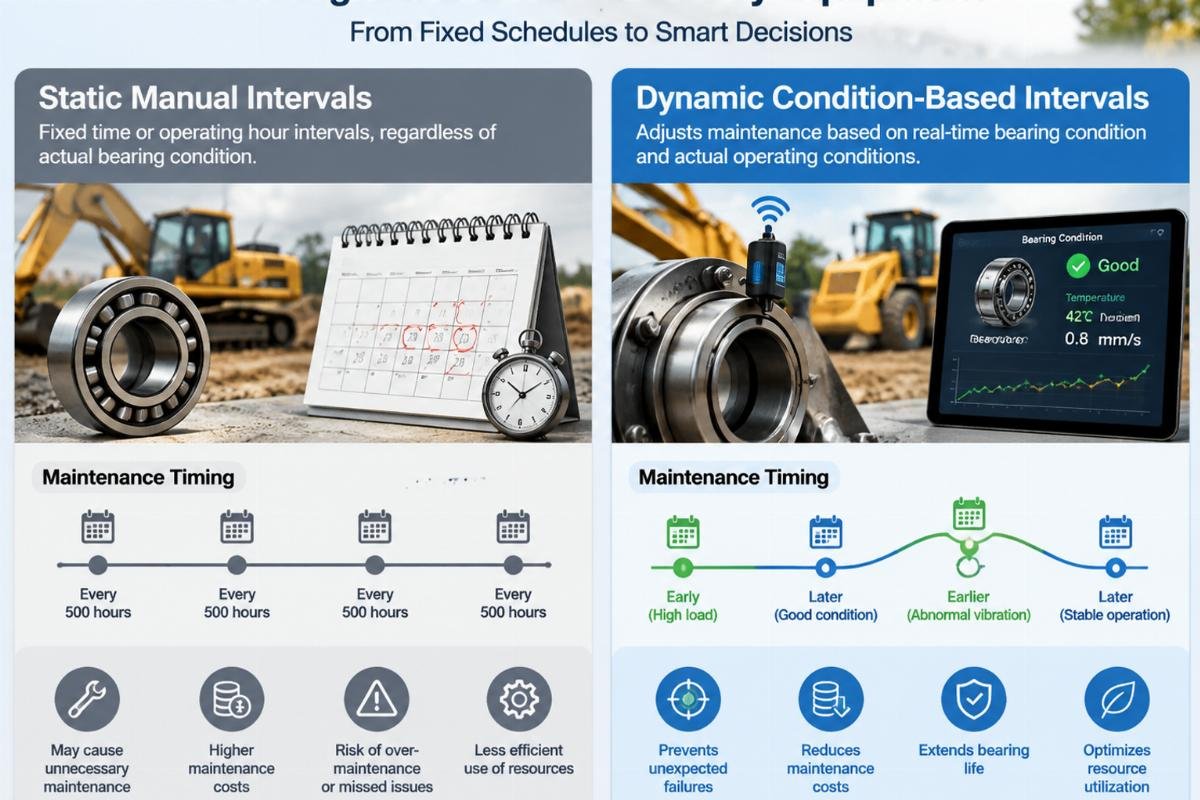
Rigid manual intervals ignore actual site temperatures and loads. Most manufacturer catalogs provide relubrication intervals based on ideal laboratory conditions. They assume a constant speed, a stable temperature, and a clean environment. Real-world heavy equipment operates in none of these states.
In a cement plant kiln application, I observed rollers skidding due to under-lubrication. The standard schedule suggested a monthly top-up. However, the actual load capacity and thermal expansion in that zone required a different approach. The grease was burning off faster than the schedule accounted for, leading to metal-to-metal contact. Conversely, in a high-humidity coastal port, a fixed schedule led to over-greasing, where the purge effect was insufficient to remove contaminated old grease, causing corrosion instead of protection.
The core issue is that static schedules do not account for dynamic variables. [NEED_CITE: impact of operating temperature on grease life per ISO standards]. When you apply a generic table to a specific machine, you are guessing. A plant lubrication program setup must start by acknowledging that the manual is a baseline, not a rule. It provides a starting point, but the final interval must be derived from the machine’s actual behavior. Without this shift in mindset, maintenance teams are merely following instructions while watching equipment degrade.
How to Assess Site Conditions Before Designing the Program?
On-site temperature mapping and load analysis are mandatory first steps. You cannot design a lubrication strategy from a desk. You must walk the floor. Before selecting a grease or setting an interval, you need to know the thermal profile of the bearing housing and the mechanical load it carries.
Start with temperature mapping. Use infrared thermometers or thermal cameras to record surface temperatures at different times of the day and under varying loads. In a steel mill conveyor system, we found that bearings in high-temperature zones were running significantly hotter than the ambient air suggested. This heat directly impacts the grease’s dropping point. If the operating temperature approaches the grease’s dropping point, the lubricant will lose its structure and leak out, leaving the bearing dry.
Next, analyze the load. Is the bearing subjected to constant heavy loads, or are there shock loads? Shock loads can break down the grease film faster than steady loads. In the nickel mine crusher, the shock loads from large ore chunks were a critical factor that the original schedule ignored. By documenting these conditions, you create a baseline for your plant lubrication program setup. This data allows you to move from guesswork to engineering. It also helps in identifying which bearings are critical and require more frequent monitoring versus those that can run on longer intervals.

What Are the Correct Grease Selection and Volume Rules?
Match grease dropping points to ambient heat and calculate exact cavity fill ratios. Selecting the right grease is not just about choosing a brand; it is about matching chemical properties to physical conditions. The two most critical factors are the dropping point and the base oil viscosity.
For high-temperature applications, such as the steel mill conveyor mentioned earlier, you need a grease with a high dropping point to prevent melting. Lithium complex or polyurea-based greases often perform better here than simple lithium soaps. However, compatibility is key. Mixing incompatible greases can cause them to soften and leak out entirely. [NEED_CITE: grease compatibility charts and mixing risks]. Always verify compatibility before switching types.
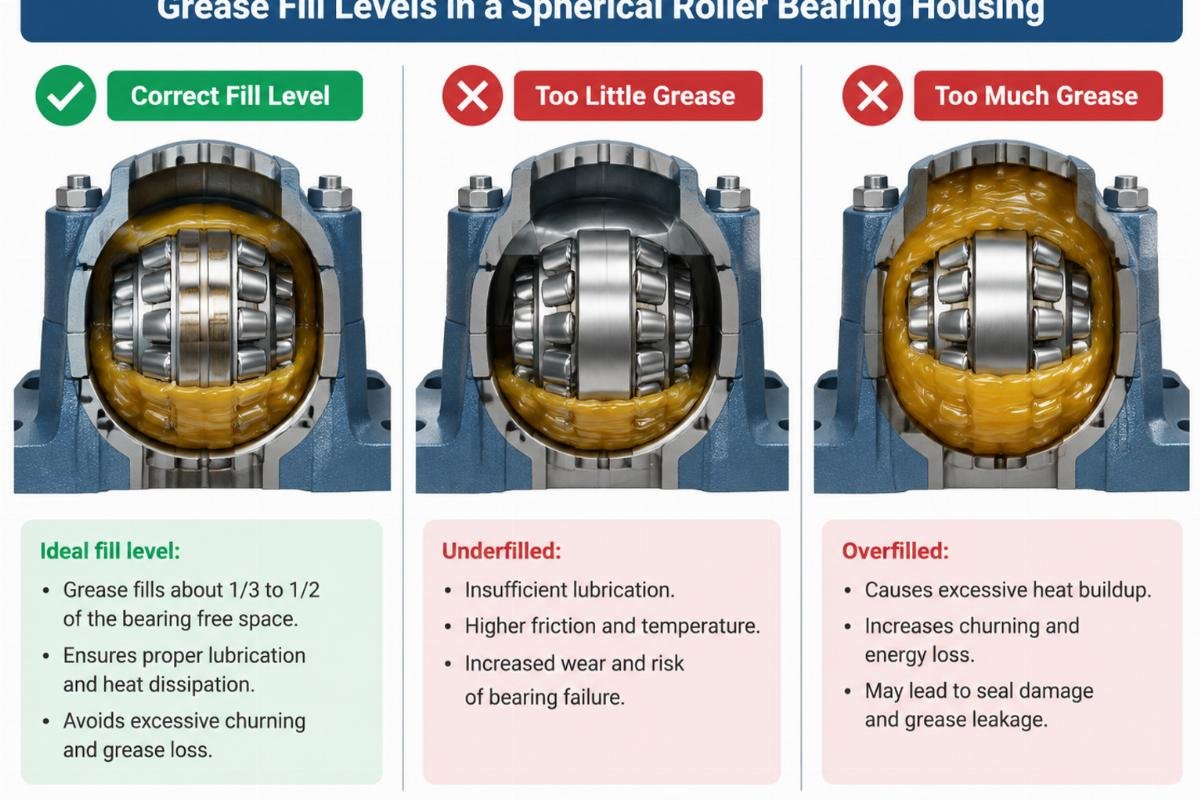
Volume calculation is where most errors occur. A common myth is that more grease is better. In reality, over-greasing causes churning. The rolling elements have to push through the excess grease, which generates heat and increases energy consumption. The general rule for spherical roller bearings is to fill one-third to one-half of the free space in the housing. For high-speed applications, even less may be required.
| Condition | Grease Type Focus | Fill Ratio Guideline | Risk of Error |
|---|---|---|---|
| High Temperature | High dropping point, synthetic base oil | 30-40% of free space | Melting, leakage, oxidation |
| High Speed | Low consistency, low friction additive | 20-30% of free space | Churning, overheating, seal damage |
| Heavy Load | High viscosity base oil, EP additives | 40-50% of free space | Film breakdown, metal contact |
| Wet/Corrosive | Water-resistant, calcium sulfonate | 50% of free space (with purge) | Washout, corrosion, rust |
This table provides a qualitative framework for decision-making. Exact percentages may vary by manufacturer specifications, but the principle remains: calculate the volume based on the housing geometry and operating speed. A proper plant lubrication program setup includes these calculated volumes in the work orders, ensuring technicians do not just “pump until it comes out.”
How to Calculate and Adjust Relubrication Intervals?
Use dynamic formulas based on operating hours and adjust via condition monitoring. Once you have the right grease and volume, you need to determine how often to add it. Standard formulas exist, such as those provided by major bearing manufacturers, which factor in bearing size, speed, and temperature. However, these formulas provide a theoretical maximum.
In practice, you should start with a conservative interval and then extend it based on evidence. Ultrasonic lubrication monitoring is a powerful tool here. It listens to the friction noise of the bearing. When the grease film thins, the friction noise increases. By adding grease until the noise drops to a baseline level, you ensure you are adding only what is needed. This method prevents both under and over-lubrication.
In a recent project with a mining client, we implemented ultrasonic monitoring on their crusher bearings. The initial manual schedule called for weekly greasing. The ultrasonic data showed that the bearings retained adequate lubrication for nearly three weeks. By adjusting the interval, we reduced grease consumption and eliminated the risk of over-greasing. This dynamic adjustment is the heart of an effective plant lubrication program setup. It turns maintenance from a routine task into a precision operation.
Regularly review these intervals. Seasonal changes, production rate increases, or equipment modifications can all alter the lubrication requirements. Keep records of each relubrication event, including the amount added and the condition of the purged grease. Discolored or gritty grease indicates contamination or degradation, signaling a need for more frequent changes or a review of sealing effectiveness.

Conclusion
Lubrication is a science, not a ritual. Moving away from rigid schedules to condition-based practices saves bearings and production time. By assessing site conditions, selecting the correct grease, calculating precise volumes, and adjusting intervals with monitoring tools, you create a resilient system. This approach minimizes unplanned downtime and extends the life of your assets. For complex operations, having access to genuine bearings and technical support ensures that when replacements are needed, they meet the exact specifications of your optimized program. A well-executed plant lubrication program setup is the foundation of reliable heavy equipment maintenance.


