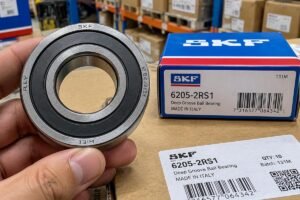
Genuine District Cooling Plant Bearings Wholesale Supplier
Standard clearance bearings fail in district cooling plants because they cannot accommodate thermal expansion.
Selecting the correct bearing clearance and type for district cooling plant pumps and fans is critical to prevent thermal expansion failures in high-temperature, high-humidity environments. Standard C0 clearance often leads to rotor seizure under heat load, while C3 or C4 clearance allows necessary expansion. Spherical roller bearings are preferred for their ability to handle misalignment and heavy loads in these demanding conditions.
I learned this lesson the hard way at a port in Qingdao, staring at a customs declaration that looked perfect on paper but was fatally flawed in practice. The shipment was destined for a regional cooling pump station in Antofagasta, Chile. The order consisted of spherical roller bearings, a robust choice for heavy loads. However, the documentation omitted a single suffix: C3. In the scorching, humid coastal climate, the standard internal clearance was insufficient. As the pumps ran, the heat generated by friction and the ambient temperature caused the inner rings to expand. Without the extra room provided by C3 clearance, the rolling elements bound against the raceways. The result was immediate rotor seizure. The emergency solution involved air freighting genuine SKF replacements, with shipping costs exceeding the value of the cargo itself. That incident shifted my focus from merely matching part numbers to verifying operational context and documentation details for every District Cooling Plant Bearings order.
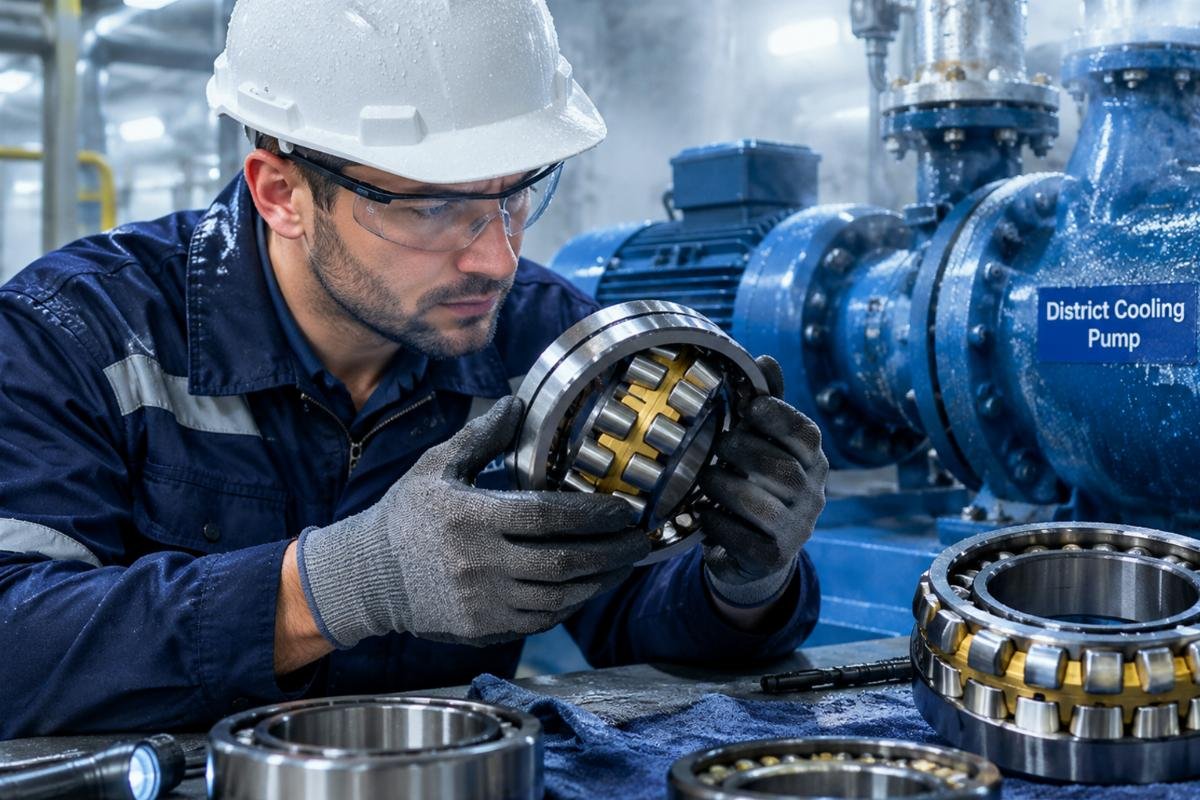
This experience underscores why technical precision matters more than brand loyalty alone. When sourcing District Cooling Plant Bearings, the interplay between material science, thermal dynamics, and logistical accuracy determines whether a plant runs smoothly or faces catastrophic downtime.
What are the unique operating conditions of district cooling plants?
High heat and humidity demand specific bearing specs that differ from standard industrial applications.
District cooling systems operate in a paradoxical environment. While they produce chilled water for distribution, the generation side—often located in coastal or tropical regions—exposes equipment to extreme ambient temperatures and high humidity. This combination creates a hostile environment for standard mechanical components. The primary challenge is not just the load, but the thermal gradient. Pumps and fans run continuously, generating internal heat, while the surrounding air offers little relief due to high humidity levels that impede evaporation and cooling efficiency.
In such conditions, lubrication films behave differently. The Stribeck curve indicates that viscosity changes significantly with temperature. If the bearing clearance is too tight, the oil film may break down, leading to metal-to-metal contact. Conversely, if the clearance is too loose, vibration increases, accelerating fatigue. [NEED_CITE: impact of humidity and temperature on lubrication viscosity in continuous operation]
For MRO operators and OEMs, understanding these conditions is the first step in selecting District Cooling Plant Bearings. It is not enough to choose a bearing that fits the shaft; it must fit the environment. Coastal plants face additional corrosion risks, requiring seals and materials that resist salt mist. The constant thermal cycling causes expansion and contraction, which can loosen fits or cause fretting corrosion if the bearing is not properly seated.

The key takeaway is that standard industrial assumptions do not apply. A bearing that performs well in a temperate factory floor may fail within months in a district cooling plant. This necessitates a shift in selection criteria, prioritizing thermal stability and corrosion resistance alongside load capacity.
Why is bearing clearance (C3/C4) critical for cooling pumps?
Thermal expansion causes standard clearance bearings to seize, making C3 or C4 clearance mandatory for high-temperature zones.
Most engineers assume standard clearance (C0) is safe for general applications. In district cooling, this assumption is dangerous. As the pump operates, the inner ring heats up faster than the outer ring due to direct contact with the hot motor shaft and fluid friction. This differential heating causes the inner ring to expand radially. If the initial internal clearance is standard, this expansion eliminates the running clearance, leading to pre-load. Pre-load increases friction, which generates more heat, creating a runaway thermal failure loop.
Using C3 or C4 clearance provides the necessary space for this thermal expansion. C3 clearance is typically sufficient for most district cooling pumps, while C4 may be required for extremely high-temperature applications or where significant shaft expansion is expected. [NEED_CITE: ISO standards for bearing clearance selection based on operating temperature]
| Clearance Class | Typical Application | Thermal Expansion Handling | Risk in High Temp |
|---|---|---|---|
| C0 (Standard) | General industrial motors | Low | High risk of seizure |
| C3 | District cooling pumps | Moderate | Suitable for most cases |
| C4 | High-temp fans/heavy loads | High | Optimal for extreme heat |
A common mistake is ordering bearings without specifying the clearance suffix. Manufacturers often default to C0 unless specified otherwise. This omission can lead to total project failure, as seen in the Antofagasta case. When importing District Cooling Plant Bearings, verifying the clearance suffix on customs documents is as critical as checking the part number. A mismatch here means the wrong product arrives, and re-exporting or destroying incorrect stock incurs significant costs.
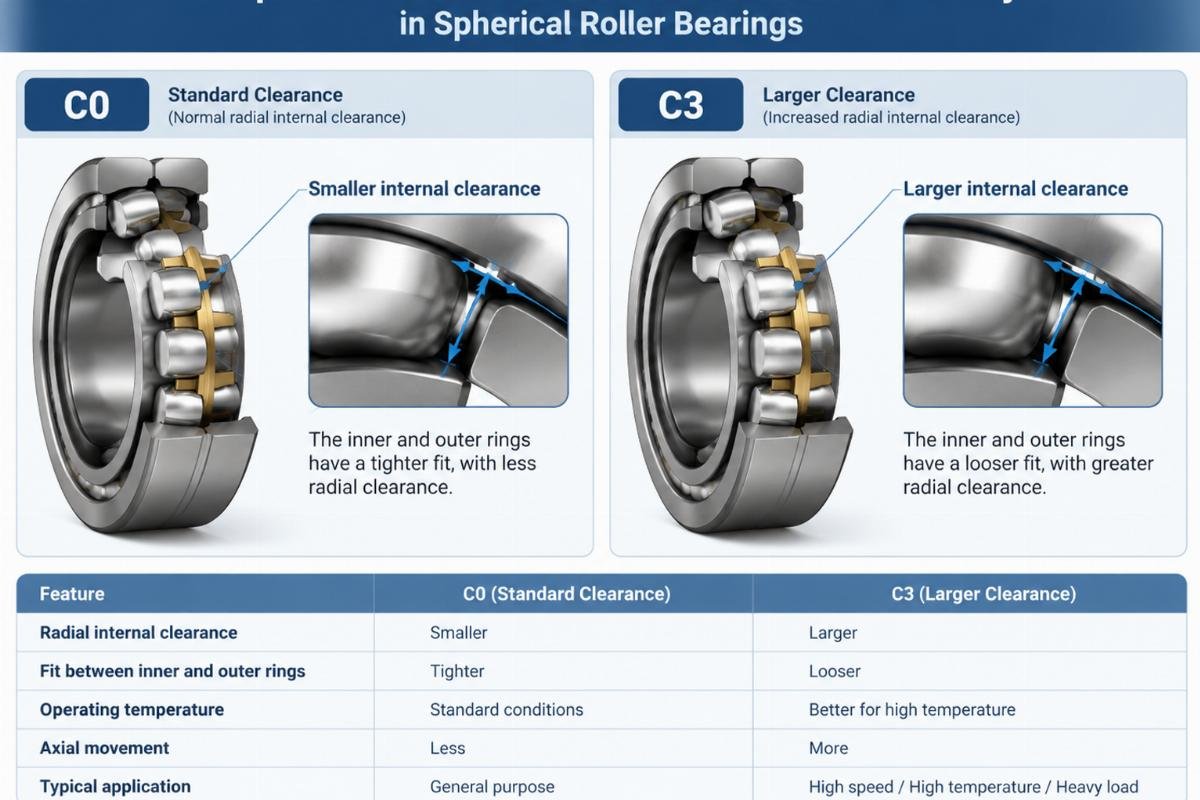
The solution is strict verification. Every purchase order must explicitly state the required clearance. For critical pumps, requesting certification that confirms the clearance class can prevent on-site surprises. This level of detail separates professional procurement from amateur buying.
How to select the right bearing types for fans and pumps?
Spherical roller bearings handle misalignment and heavy loads best, making them ideal for district cooling applications.
While deep groove ball bearings are common in light-duty applications, district cooling pumps and fans often face heavy radial loads and potential misalignment. Shaft deflection due to long spans or thermal growth can misalign bearings, causing edge loading and premature failure. Spherical roller bearings are designed to accommodate angular misalignment, making them the preferred choice for these demanding roles.
For fans, which may operate at higher speeds and face axial thrust from air movement, angular contact ball bearings or cylindrical roller bearings might be considered. However, spherical roller bearings offer a robust balance of load capacity and misalignment tolerance. They are particularly effective in handling the shock loads that can occur during startup or sudden flow changes in the cooling network.
When selecting District Cooling Plant Bearings, consider the specific role of the component. Pumps require high radial load capacity and resistance to thermal expansion, favoring spherical roller bearings with C3 clearance. Fans may need lighter, faster-running bearings, but still benefit from the durability of spherical designs if misalignment is a concern. [NEED_CITE: API standards for pump bearing selection and load analysis]
A European wind farm operator once faced repeated fan bearing failures due to slight tower flex causing misalignment. Switching to spherical roller bearings resolved the issue, extending service life noticeably. This principle applies equally to district cooling fans, where structural vibrations and thermal shifts can create similar misalignment challenges.
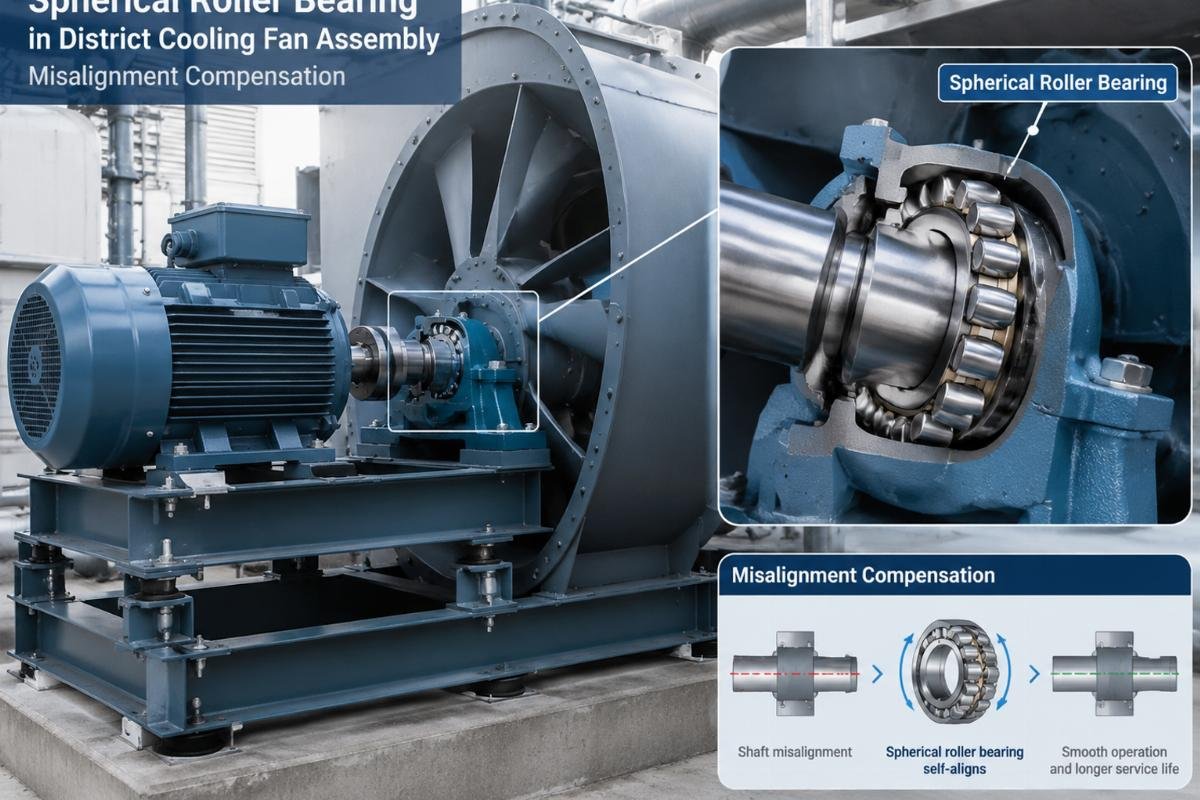
The key is to match the bearing type to the mechanical stresses. Do not default to the cheapest option. Instead, analyze the load profile and alignment risks. Sourcing genuine multi-brand options allows for selecting the best technical fit rather than being locked into a single manufacturer’s portfolio.
What procurement details prevent on-site installation failures?
Strict verification of clearance suffixes in customs documents is mandatory to avoid receiving incorrect stock.
The final hurdle in securing reliable District Cooling Plant Bearings is not technical selection, but logistical accuracy. A correct part number with the wrong clearance suffix is useless. Even worse, if the customs documentation does not match the physical goods, shipments can be held, inspected, or rejected, causing delays that halt maintenance schedules.
In mixed-brand consolidation orders, this risk increases. Different manufacturers use different suffixes for similar clearance classes. For example, one brand may use “C3” while another uses a different code for equivalent clearance. Ensuring that the commercial invoice, packing list, and certificate of origin all reflect the correct technical specifications is essential.
| Document Type | Critical Check Point | Common Error |
|---|---|---|
| Commercial Invoice | Part Number + Suffix | Missing C3/C4 suffix |
| Packing List | Quantity + Description | Generic description without specs |
| Certificate of Origin | Brand + Model | Mismatch with physical goods |
A Middle East steel mill once received a container of bearings where the packing list described “standard bearings” instead of specifying “C3 clearance.” Although the bearings inside were correct, the ambiguity caused a week-long customs delay while inspectors verified the contents. This delay forced the plant to run on degraded equipment, increasing the risk of failure.
To prevent such issues, work with suppliers who provide strict document verification. Request pre-shipment photos of the bearing labels and packaging. Ensure that the supplier understands the importance of these details for your specific region’s customs requirements. Flexible MOQs allow for ordering small batches of critical spares with full documentation, reducing the risk associated with large, heterogeneous shipments.

Procurement is not just about buying parts; it is about buying certainty. Verifying every detail from order to delivery ensures that the District Cooling Plant Bearings you receive are ready for immediate installation, minimizing unplanned downtime.
Conclusion
Correct clearance and type selection prevent thermal failure in district cooling systems.
Choosing the right bearings for district cooling plants requires more than matching part numbers. It demands an understanding of thermal expansion, misalignment risks, and logistical precision. C3 or C4 clearance spherical roller bearings offer the best protection against heat-induced seizure and mechanical stress. Ensuring that documentation accurately reflects these specifications prevents costly delays and installation failures. By focusing on these technical and procedural details, operators can maintain reliable cooling operations even in the harshest environments.