
Bearing Failure Root Cause Analysis: Expert Guide from Global Supplier
Most premature bearing failures are not caused by defective materials.
Effective failure analysis requires on-site inspection of installation and environmental factors, not just lab material testing. By following a structured field method to identify improper clearance, contamination, or lubrication issues, operators can resolve the root cause rather than simply replacing the component with an identical unit that will fail again.
The smell of burnt grease in a confined space tells a story that laboratory reports often miss. Years ago, standing in the humid, dust-choked巷道 of a platinum mine in South Africa, I watched a maintenance team struggle with a main drive shaft that had failed yet again. The spherical roller bearing had spalled after less than three months of operation. The mine management was convinced we had supplied substandard stock, pointing fingers at the manufacturer’s quality control. However, dismantling the housing revealed no manufacturing defects in the raceways. Instead, the evidence pointed to excessive axial clearance and fine particulate ingress during installation. This incident reinforced a critical lesson: blaming the metal is easy, but diagnosing the application is where true reliability engineering begins. [NEED_CITE: common misconceptions regarding bearing material quality vs application errors]
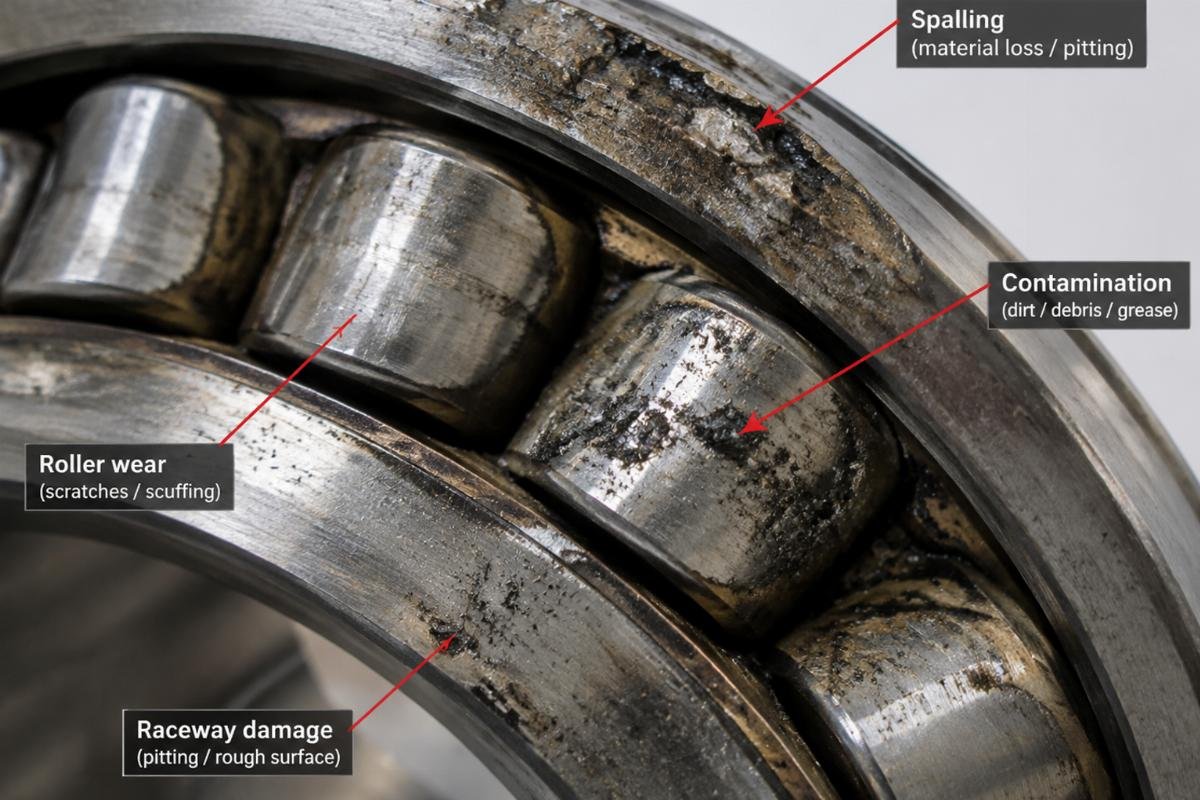
Understanding why components fail prematurely shifts the focus from supplier blame to operational conditions. While material fatigue is inevitable over time, early failure usually stems from external forces acting upon the bearing. A comprehensive Bearing Failure Root Cause Analysis Template helps technicians systematically eliminate variables, ensuring that the replacement part addresses the actual problem rather than just the symptom.
Why Do Bearings Fail Prematurely?
The majority of early bearing failures stem from improper installation or contamination, not inherent material defects.
It is counter-intuitive for many procurement managers and maintenance leads to accept that a premium brand bearing can fail quickly if the surrounding ecosystem is flawed. Industry data suggests that a significant portion of failures are attributable to handling and mounting errors rather than manufacturing flaws. [NEED_CITE: statistical distribution of bearing failure causes per ABMA standards] When a bearing arrives in its original packaging, it is in perfect condition. The degradation begins the moment it is exposed to the site environment.
In heavy industries like mining and steel production, the operating environment is hostile. Dust, moisture, and extreme temperatures create conditions that standard seals may not withstand without proper auxiliary protection. For instance, in a steel plant scenario, roller bearings often suffer from overheating not because the steel cannot handle the load, but because the lubrication intervals were not adjusted for the high-ambient temperature. The grease oxidizes faster, losing its film strength, leading to metal-to-metal contact.
Another frequent culprit is misalignment. In pump stations, ball bearings may generate excessive noise and vibration due to shaft misalignment. This creates uneven load distribution across the rolling elements, causing localized stress concentrations that lead to premature fatigue. Without correcting the alignment, even the highest precision bearing will succumb to these artificial stresses. Recognizing these patterns is the first step in applying a Bearing Failure Root Cause Analysis Template effectively. It moves the conversation from “why did this break” to “what condition caused this break.”

How to Conduct On-Site Failure Analysis?
Follow a four-step field inspection template to capture critical data before cleaning or discarding the failed component.
Conducting a thorough analysis requires discipline. The temptation to immediately clean the part and install a new one is strong, especially during urgent downtime events. However, preserving the state of failure is crucial for accurate diagnosis. The methodology aligns with international standards for damage classification, ensuring that observations are consistent and actionable. [NEED_CITE: ISO 15243 damage and failure classification guidelines]
- Visual Documentation and Initial Assessment: Before touching the bearing, photograph the assembly in situ. Note the position of the bearing, the condition of the housing, and any visible leaks or seal damage. Look for discoloration on the outer ring, which indicates overheating, or rust streaks that suggest water ingress. This step captures the environmental context that a lab test cannot replicate.
- Disassembly and Cleaning: Carefully remove the bearing, avoiding further damage to the rolling elements. Clean the component gently to remove bulk contaminants, but preserve any adhered debris for analysis. The type of contaminant—whether it is metallic wear particles, sand, or carbon dust—provides clues about the source of the problem. For example, fine silica dust points to inadequate sealing in dusty environments, while metallic shards suggest cage failure or severe overload.
- Measurement and Clearance Check: Use precision tools to measure the internal clearance and check for dimensional changes in the shaft and housing. Improper fit is a leading cause of failure. If the bearing was mounted with excessive interference, the internal clearance may have been reduced to zero, causing overheating and seizure. Conversely, too loose a fit allows creep and fretting corrosion. Comparing these measurements against the manufacturer’s specifications helps determine if the mounting process was correct.
- Lubricant Analysis: Sample the remaining grease or oil. Check for consistency, color, and odor. Oxidized grease appears dark and hard, while contaminated lubricant may feel gritty. In some cases, sending a sample for laboratory analysis can reveal chemical breakdown or specific contaminant types. This step is vital for adjusting maintenance schedules and selecting the right lubricant grade for the operating conditions.
By strictly adhering to this sequence, technicians can gather sufficient data to populate a Bearing Failure Root Cause Analysis Template accurately. This structured approach prevents guesswork and ensures that corrective actions are based on evidence.

What Are the Most Common Failure Patterns?
Match visual damage like spalling or brinelling to specific root causes to identify the underlying issue.
Different failure modes leave distinct signatures on the bearing surfaces. Recognizing these patterns allows for quick identification of the root cause. The following table outlines common visual indicators and their likely origins, helping technicians diagnose issues without extensive laboratory testing.
| Visual Damage Pattern | Likely Root Cause | Corrective Action Focus |
|---|---|---|
| Spalling (Flaking) | Fatigue due to overload or improper clearance | Verify load calculations and adjust mounting clearance |
| Brinelling (Dents) | Static overload or impact during installation | Improve handling procedures and check housing integrity |
| Smearing/Scuffing | Insufficient lubrication or high-speed slip | Review lubricant viscosity and replenishment intervals |
| Corrosion/Rust | Water ingress or corrosive atmosphere | Enhance sealing solutions and use corrosion-resistant materials |
| Discoloration (Blue/Brown) | Overheating due to friction or electrical current | Check lubrication flow and ensure proper grounding |
[NEED_CITE: visual identification guide for bearing damage modes]
Consider the case of a mining crusher where spherical roller bearings repeatedly suffered from spalling. Initial assumptions pointed to excessive vibration from the crushing process. However, a detailed inspection using the Bearing Failure Root Cause Analysis Template revealed that the internal clearance was too tight for the thermal expansion experienced during operation. The bearing essentially locked up as it heated, generating excessive internal stress. Adjusting the clearance specification resolved the issue, extending the service life significantly.
Similarly, in a paper mill application, bearings exhibited signs of electrical fluting. This pattern, characterized by small washboard-like ridges on the raceways, indicated stray currents passing through the bearing. The solution was not a harder bearing, but the installation of insulated bearings or grounding brushes to divert the current. These examples illustrate that the visual pattern is a direct map to the physical cause.

How to Prevent Recurring Failures?
Implement corrective actions for installation and maintenance to break the cycle of repeated failures.
Identifying the root cause is only half the battle; preventing recurrence requires systemic changes. Simply replacing a failed bearing with the same model guarantees a repeat failure if the underlying conditions remain unchanged. True reliability improvement comes from adjusting the application parameters.
For installation issues, investing in proper training and tools is essential. Hydraulic mounting tools ensure uniform pressure and prevent damage from hammer blows. Verifying shaft and housing tolerances before mounting prevents fit-related problems. In environments with high contamination risks, upgrading to bearings with enhanced sealing technologies or adding external protective covers can significantly reduce ingress.
Lubrication management is another critical area. Automated lubrication systems can ensure consistent grease delivery, eliminating human error in manual greasing intervals. Selecting the right lubricant for the specific temperature and speed conditions is vital. Regular oil analysis programs can detect early signs of degradation or contamination, allowing for proactive maintenance before catastrophic failure occurs.
Furthermore, maintaining accurate records of each failure and the subsequent corrective actions builds a knowledge base for the facility. This historical data helps in predicting future issues and optimizing maintenance schedules. When sourcing replacements, working with a supplier who provides technical support and genuine products ensures that the new bearing meets the required specifications. A reliable partner can offer insights into equivalent models that might better suit the harsh operating conditions, providing a more robust solution than the original design.

Conclusion
Root cause analysis transforms maintenance from a reactive cost center to a proactive reliability strategy.
By shifting focus from material blame to application conditions, operators can achieve significant improvements in equipment uptime. Using a structured Bearing Failure Root Cause Analysis Template ensures that every failure provides valuable data for improvement. Whether it is adjusting clearance, improving sealing, or optimizing lubrication, the key lies in understanding the specific demands of the operating environment. Genuine components combined with correct application practices form the foundation of long-term reliability.


